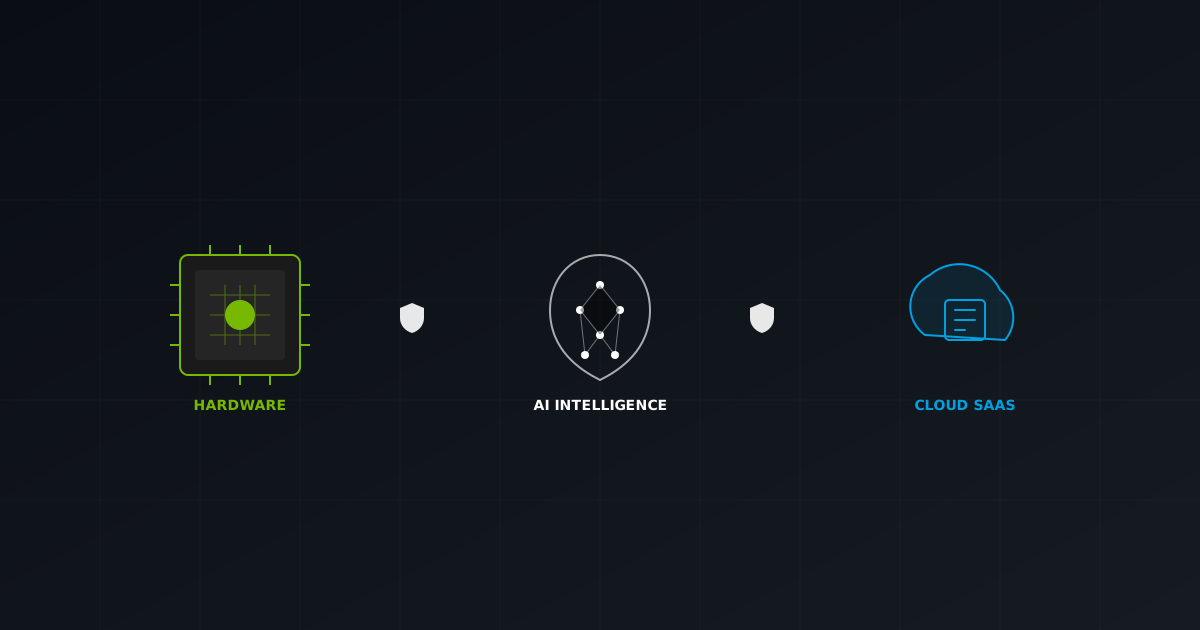
In the rapidly evolving landscape of generative AI, security is a moving target. Anthropic’s continuous push for AI safety—highlighted by their recent security announcements regarding model vulnerabilities and red-teaming methodologies—paints a clear picture: even the most robust AI models are susceptible to manipulation.
Meanwhile, Nvidia, the undisputed titan of AI infrastructure, has been closely analyzing these threat models. Through their enterprise AI frameworks and security guidelines, Nvidia acknowledges a critical reality: while hardware and foundational models can be hardened, the application layer remains incredibly vulnerable.
For SaaS companies rushing to integrate advanced LLMs, this intersection of Anthropic's model-level disclosures and Nvidia's infrastructure-level insights reveals a massive blind spot. Here is why assuming your AI provider has "handled the security" is a dangerous game, and why penetration testing is the essential bridge over this security gap.
The Shared Responsibility Model of AI SaaS
When a SaaS application integrates an API from a provider like Anthropic, a new shared responsibility model is born.
- The Infrastructure (Nvidia's Domain): Securing the silicon, the data center, and the low-level compute frameworks (like CUDA and TensorRT) against side-channel attacks and data leakage.
- The Model (Anthropic's Domain): Ensuring the foundational model is aligned, resists basic jailbreaks, and adheres to safety guardrails (e.g., Constitutional AI).
- The Application (Your Domain): Securing how user input interacts with the model, how the model accesses your databases, and how outputs are rendered back to the user.
Anthropic’s security announcements frequently emphasize that while they patch model-specific vulnerabilities, they cannot control how a model is implemented in the wild. Nvidia’s enterprise security philosophy echoes this, heavily promoting tools like NeMo Guardrails to add an intermediate layer of defense. Yet, neither can protect a SaaS platform from poor implementation logic.
Where Traditional Security Fails
SaaS platforms have historically relied on automated vulnerability scanners, Web Application Firewalls (WAFs), and static code analysis. However, AI introduces non-deterministic behavior.
If a malicious user uses a complex prompt injection attack to trick your SaaS application's AI assistant into querying another tenant's data, an automated WAF will likely let it pass. The payload looks like natural language, not a SQL injection or cross-site scripting (XSS) string. The vulnerability doesn't live in the code syntax; it lives in the business logic of how the AI's output is trusted by your backend APIs.
Penetration Testing: The Ultimate Reality Check
This is precisely where penetration testing fills the void. While Nvidia and Anthropic secure the foundation, pen testing secures the unpredictable human-AI interface.
1. Simulating Advanced Prompt Injection
Penetration testers act as adversarial users, employing the same techniques Anthropic highlights in their red-teaming reports. They attempt to bypass your specific system prompts, forcing the AI to ignore its instructions and execute unauthorized actions within your SaaS environment.
2. Testing AI-to-API Privilege Escalation
If your SaaS app grants the AI model access to internal APIs (e.g., to fetch user data or trigger workflows), it becomes a massive attack vector. Pen testers evaluate whether a compromised model can be used as a proxy to perform Server-Side Request Forgery (SSRF) or escalate privileges beyond what the human user is authorized to do.
3. Exposing Data Exfiltration Paths
Nvidia’s security frameworks heavily emphasize data privacy during inference. However, if an attacker can manipulate an LLM to summarize and output sensitive PII from a shared database, the infrastructure security is rendered moot. Pen testers actively hunt for these lateral data leaks.
Closing the Loop on AI Security
The insights from industry leaders are clear. Anthropic will continue to push the boundaries of model safety, and Nvidia will continue to build impenetrable AI fortresses at the hardware and framework level. But the moment you plug an AI model into your SaaS application, the security perimeter shifts to your front door.
To safely leverage the power of modern AI, SaaS providers must adopt continuous, AI-focused penetration testing. It is no longer just about finding broken code; it is about outsmarting the adversarial logic that threatens the integrity of your entire platform.