Modern software delivery is a symphony of automated events. A developer pushes code, a pull request is merged, a container is built, and a deployment is triggered. The invisible glue holding this entire ecosystem together? Webhooks.
But as organizations lock down their code repositories and secure their developer workstations, attackers are shifting their focus to the connective tissue of the pipeline itself. Enter the "Phantom Trigger"—a software supply chain attack where malicious actors bypass the source system entirely, forging webhook payloads to manipulate CI/CD automation.
The Anatomy of a Phantom Trigger Attack
At their core, webhooks are simply HTTP POST requests triggered by an event. When a system like GitHub or GitLab wants to notify your Jenkins, GitHub Actions, or ArgoCD server that a new commit has landed, it sends a JSON payload to a pre-configured URL.
The vulnerability arises when the receiving service implicitly trusts incoming requests. If a CI/CD server or deployment orchestrator fails to rigorously validate the authenticity of the webhook, an attacker who discovers the endpoint URL can easily craft a synthetic payload.
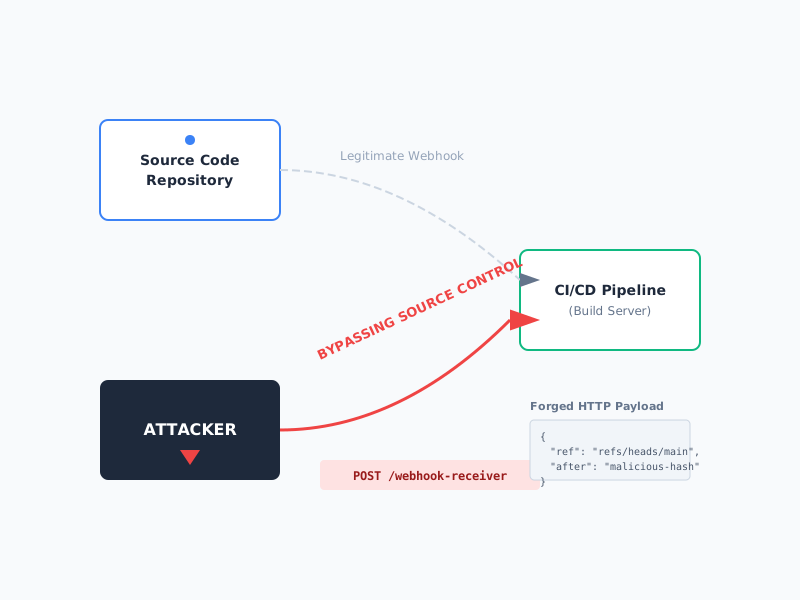 Figure 1: Visualizing how an attacker can bypass source control by spoofing unauthenticated webhook events directly to the build server.
Here is how the attack typically unfolds:
- Endpoint Discovery: Attackers scan for exposed CI/CD endpoints, scrape public documentation, or extract webhook URLs from leaked configuration files and public repositories.
- Payload Forgery: Using documentation from standard tools, the attacker crafts a JSON payload that perfectly mimics a legitimate event—such as a
pushevent containing a malicious commit hash. - Execution: The attacker sends the forged payload to the CI/CD server. Believing the request came from the trusted repository, the server provisions a runner, pulls the attacker's malicious code (or forces a rollback to a vulnerable legacy version), and executes the pipeline.
Why This Matters Now
In 2026, the widespread adoption of event-driven architectures and GitOps has inadvertently expanded the blast radius of webhook forgery. Pipelines are no longer just building code; they are provisioning cloud infrastructure, managing identity and access, and deploying directly to production.
A successful Phantom Trigger attack can lead to:
- Secret Exfiltration: An attacker can trigger a pipeline run that echoes environment variables or cloud credentials to publicly accessible build logs.
- Malicious Deployments: By forging a "release" webhook, attackers can trick deployment orchestrators into rolling out backdoored container images, bypassing standard human approval gates.
- Denial of Service (DoS): Flooding a CI/CD server with forged, resource-intensive build triggers can exhaust runner pools and halt legitimate engineering velocity.
Securing the Connective Tissue
Defending against forged event triggers requires treating your CI/CD pipeline as a zero-trust environment. Automation does not exempt a system from authentication.
1. Enforce Cryptographic Signatures (HMAC)
The most critical defense against webhook forgery is HMAC (Hash-based Message Authentication Code) signature validation. The sending system signs the payload using a shared secret, and the receiving system recalculates the signature upon receipt. If the signatures do not match, the request must be dropped immediately.
2. Implement Mutual TLS (mTLS)
Relying solely on shared secrets can be risky if those secrets are poorly rotated. Implementing mTLS between your source code management system and your CI/CD orchestrator ensures that the receiving server mathematically verifies the identity of the client sending the webhook at the transport layer.
3. Rotate Webhook Secrets Automatically
A leaked webhook secret is just as dangerous as a leaked API key. Treat webhook secrets as high-value credentials. Use enterprise secret management solutions to enforce automated, frequent rotation of all HMAC keys used across your supply chain.
4. Restrict Network Ingress
While IP allowlisting is becoming more difficult with dynamic cloud environments, restricting ingress traffic to your CI/CD orchestrator so that it only accepts connections from known source provider IP ranges adds a valuable layer of defense-in-depth.
The Bottom Line
As we fortify the endpoints of our software supply chains, we cannot afford to leave the transit layer exposed. Webhooks are powerful tools for automation, but without strict cryptographic validation, they are simply open doors waiting to be pushed. Securing your CI/CD pipeline means verifying every trigger, every time.