When industry giants speak, the security community listens. Recent security advisories and framework updates from both Nvidia and Anthropic have sent a clear message to the SaaS ecosystem: the underlying AI infrastructure might be hardening, but the integration layer remains incredibly fragile.
SaaS providers are racing to embed Nvidia's inference microservices and Anthropic’s Claude models into their platforms. However, many engineering teams operate under a dangerous assumption: if the AI provider is secure, our AI-powered features are secure.
This illusion of inherited security is exactly where threat actors are focusing their attention. Here is a deep dive into why relying solely on vendor security is a losing strategy, and how penetration testing is the only reliable way to bridge the security gap in modern AI-driven SaaS applications.
The Shared Responsibility Trap in AI SaaS
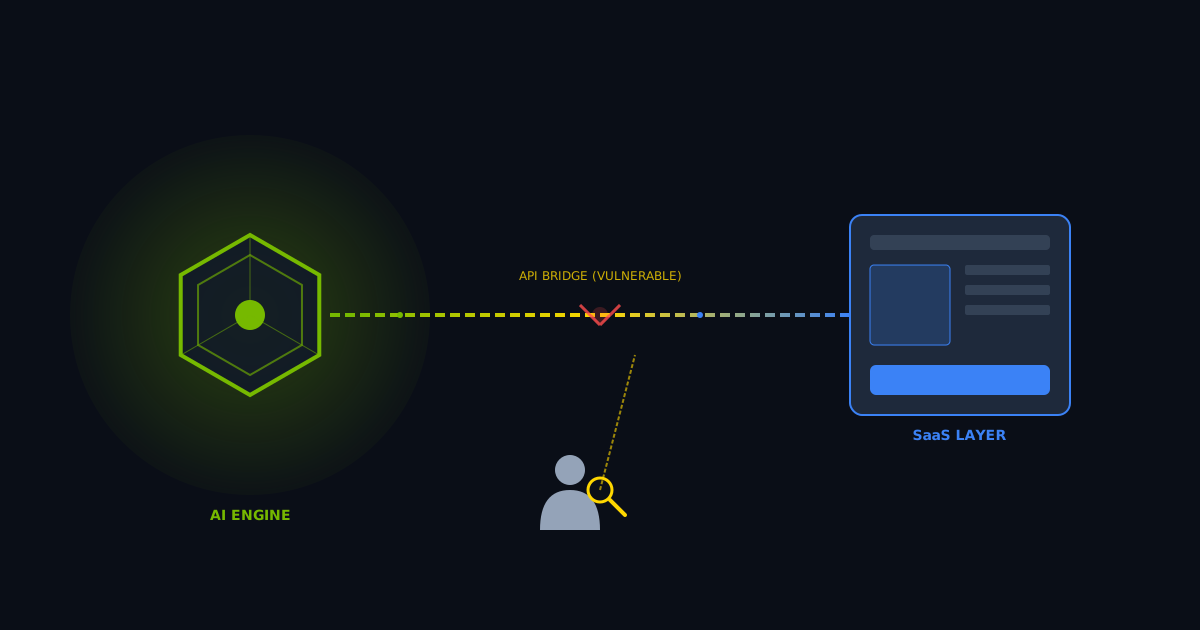
 The Shared Responsibility Model: Identifying the critical security gap where AI provider perimeters end and SaaS application logic begins.
In traditional cloud computing, the Shared Responsibility Model is well understood. AWS or Azure secures the data center; you secure the application. But in the era of Generative AI, the lines are dangerously blurred.
When Anthropic releases updates regarding Claude's tool-use (function calling) boundaries, or Nvidia patches vulnerabilities in their NeMo framework or Triton Inference Server, they are securing their perimeter. They are not—and cannot—secure how your application handles the data passed back and forth.
If a user prompts your SaaS application to perform a malicious action, the LLM might correctly identify and refuse the prompt based on Anthropic’s guardrails. But what if the attacker bypasses the prompt and directly attacks the API endpoint your SaaS uses to communicate with the model?
What the Announcements Actually Mean for Your SaaS
Analyzing the subtext of recent security bulletins from AI leaders reveals three critical vulnerability zones for SaaS applications:
1. Tool-Use and Agentic Workflows
Anthropic’s push into agentic workflows and the Model Context Protocol (MCP) allows Claude to interact directly with your SaaS application's internal APIs. Recent security discussions highlight the risk of Confused Deputy Attacks. If your SaaS grants the AI agent broad permissions, an attacker can use prompt injection to trick the model into executing unauthorized API calls on their behalf.
2. Inference Infrastructure Leaks
Nvidia's enterprise AI software stack is robust, but advisories often point to misconfigurations in how these models are deployed and queried. If your SaaS hosts custom models using Nvidia's architecture, improper network segmentation between the inference server and your primary SaaS database can lead to Server-Side Request Forgery (SSRF) or unauthorized data exfiltration.
3. Context Window Poisoning
Both companies have highlighted the ongoing challenge of indirect prompt injection. If your SaaS application feeds user-generated content, external web pages, or third-party documents into an LLM's context window, you are introducing untrusted data into a trusted execution environment.
How Penetration Testing Fills the Void
Automated vulnerability scanners and standard compliance audits fall short when dealing with non-deterministic AI features. Penetration testing is uniquely positioned to uncover the logical and architectural flaws that emerge when SaaS meets AI.
Here is how modern penetration testing specifically addresses these gaps:
Validating the "Seams" of Integration
Penetration testers don't waste time trying to hack Anthropic's core models. Instead, they target the seams—the APIs, webhooks, and data pipelines connecting your SaaS to the AI provider. Testers will attempt to intercept traffic, manipulate API requests, and bypass your application's input sanitization before the data ever reaches the LLM.
Testing Function-Calling Guardrails
If your application uses Anthropic's tool-use capabilities to query a database or trigger an email, pen testers will actively attempt to manipulate the parameters the LLM passes back to your system. They test whether your backend blindly trusts the LLM's output or if it enforces strict schema validation and role-based access controls (RBAC) on the executed functions.
Simulating Multi-Stage AI Attacks
Real-world attacks rarely rely on a single vulnerability. A penetration test will simulate how an attacker might chain an indirect prompt injection flaw with a poorly configured Nvidia Triton server to achieve Remote Code Execution (RCE) or access cross-tenant data in your SaaS environment. This context-aware testing is impossible to achieve with automated tools.
The Path Forward: Trust, but Verify
The security updates from Nvidia and Anthropic shouldn't be viewed as red flags about their platforms, but rather as a wake-up call for the SaaS vendors building on top of them. The AI providers are doing their part to secure the foundation. The responsibility of securing the house built on top of it falls entirely on you.
To ensure your AI integrations are a business enabler rather than a liability:
- Map your AI attack surface: Document every API endpoint, webhook, and database that interacts with an LLM.
- Implement zero-trust for AI outputs: Treat all data returning from an AI model as untrusted user input.
- Schedule an AI-focused penetration test: Traditional web app pen tests are no longer sufficient. Ensure your testing partner understands LLM architectures, prompt injection vectors, and agentic workflow vulnerabilities.
The gap between a secure AI model and a secure SaaS application is wide. Penetration testing is the bridge that gets you safely to the other side.