 The evolution from classical encryption to quantum-resistant architectures in the modern supply chain.
The software supply chain has spent the last five years obsessed with dependencies. We've mandated Software Bill of Materials (SBOMs), mapped out transitive libraries, and built massive databases of known vulnerabilities. But as we navigate 2026, a new, arguably more insidious threat is emerging from the depths of our codebases: cryptographic debt.
With the National Institute of Standards and Technology (NIST) finalizing its Post-Quantum Cryptography (PQC) standards, the theoretical threat of quantum computers breaking traditional encryption is becoming a practical compliance and security mandate. The problem? Most organizations have no idea where vulnerable cryptographic algorithms are hiding in their supply chains.
Enter the Cryptographic Bill of Materials (CBOM).
The "Harvest Now, Decrypt Later" Threat to Pipelines
The urgency around post-quantum cryptography isn't just about protecting real-time communications; it's about protecting the integrity of the software supply chain itself. Threat actors are increasingly employing "harvest now, decrypt later" strategies. They are scraping encrypted environment variables, intercepting proprietary compiled binaries, and archiving digitally signed commits.
When cryptographically relevant quantum computers (CRQCs) come online, any artifact secured by legacy algorithms (like RSA or ECC) will be easily compromised. If an attacker can forge a digital signature from a 2025 software release, they can impersonate trusted maintainers, bypass code signing checks, and inject malicious updates into legacy systems that still trust those old keys.
Why Your SBOM Isn't Enough
If you're already suffering from "SBOM fatigue," the idea of another acronym might induce a groan. However, traditional SBOMs are designed to track components—libraries, frameworks, and packages. They are notoriously bad at tracking behaviors and algorithms.
A standard SBOM will tell you that your application uses OpenSSL 3.0.8. It will not tell you:
- Which specific encryption algorithms are being invoked by your application.
- Where hardcoded cryptographic keys or initialization vectors (IVs) reside.
- Which hashing algorithms are used to sign your internal build artifacts.
- Whether your third-party SaaS integrations rely on deprecated TLS configurations.
A CBOM is a specialized extension of the SBOM (often implemented via CycloneDX extensions) that inventories the cryptographic assets across your entire software portfolio.
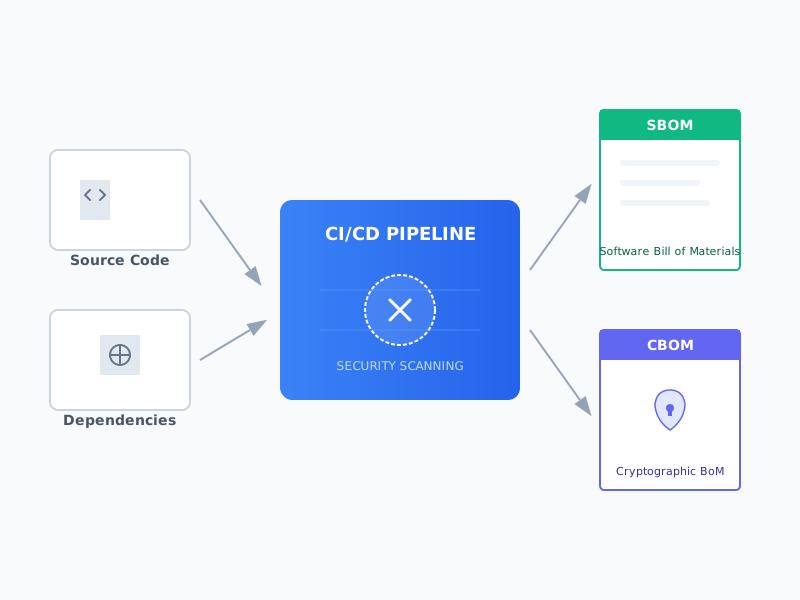 Figure 1: Automated generation of SBOMs and CBOMs within the modern DevSecOps pipeline.
Achieving Cryptographic Agility in CI/CD
The transition to PQC won't happen overnight, but the discovery phase must start immediately. True cryptographic agility means your software architecture can swap out outdated algorithms for post-quantum replacements without requiring a massive, system-breaking rewrite.
Here is how modern engineering teams are embedding CBOMs and crypto-agility into their pipelines:
1. Automated Cryptographic Discovery
Static Application Security Testing (SAST) tools and specialized CBOM generators must be integrated into the CI/CD pipeline. These tools scan source code and compiled binaries to flag deprecated algorithms (e.g., MD5, SHA-1, RSA-2048) and map where cryptographic libraries are called.
2. Failing Builds on Crypto-Violations
Just as you would fail a build for a critical CVE or an exposed secret, pipelines in 2026 are beginning to enforce cryptographic policies. If a developer introduces a new dependency that relies on an outdated hashing algorithm for data integrity, the pipeline should block the merge request.
3. Securing the Build Artifacts
Your build provenance (SLSA attestations) and container signatures (via tools like Sigstore/Cosign) must be upgraded. Ensure that the infrastructure signing your releases is capable of supporting hybrid cryptographic schemes—combining traditional algorithms with new PQC algorithms to provide a safety net during the transition period.
The Clock is Ticking
We can no longer treat cryptography as a "set it and forget it" feature of software development. The algorithms we rely on to secure our pipelines, authenticate our machine identities, and sign our releases are operating on borrowed time.
By integrating CBOM generation into your software supply chain today, you move away from reactive panic and toward proactive cryptographic agility. The quantum era is arriving—make sure your pipeline is ready for it.