When the details of CVE-2026-3055 broke earlier this week, the cybersecurity community let out a collective gasp. It wasn't just the severity of the vulnerability—a critical cross-tenant authorization bypass in a globally utilized enterprise SaaS platform—it was the victim. The compromised entity is a tech behemoth renowned for its seemingly bottomless security budget, continuous red-teaming, and extensive, top-tier SaaS penetration testing.
If a corporation with millions dedicated to offensive security can fall victim to a fundamental logic flaw, what hope does a growing SaaS startup have?
The answer lies not in how much you spend on penetration testing, but when you start doing it. CVE-2026-3055 is a harsh reminder that no amount of late-stage security spending can patch a broken foundation.
The Anatomy of CVE-2026-3055
While the full post-mortem is still under NDA for many affected organizations, the core mechanics of CVE-2026-3055 revolve around an intricate business logic flaw. Attackers discovered that by manipulating a sequence of legacy API endpoints during the OAuth token exchange process, they could force the application to misinterpret tenant IDs.
This wasn't a simple SQL injection or a missing security header that an automated scanner could flag. It was a deep, architectural oversight.
So, how did the enterprise's extensive penetration testing miss it?
Because the flaw was baked into the application's foundational architecture years ago. By the time the company reached the size where it could afford "extensive" penetration testing, the application had grown into a sprawling monolith of microservices. Penetration testers were forced to focus on new features, perimeter defenses, and compliance checklists, while the underlying legacy logic remained a black box, obscured by years of technical debt.
The Enterprise Penetration Testing Paradox
There is a dangerous myth in the SaaS industry: "We will worry about deep penetration testing once we have enterprise revenue."
This mindset creates the Enterprise Penetration Testing Paradox. By the time a company has the resources to hire elite offensive security teams, their attack surface is so massive and complex that even the best testers can only scratch the surface within a given engagement window.
When you bolt security onto an application years after it was first exposed to the internet, you aren't fixing the foundation; you are just painting over the cracks.
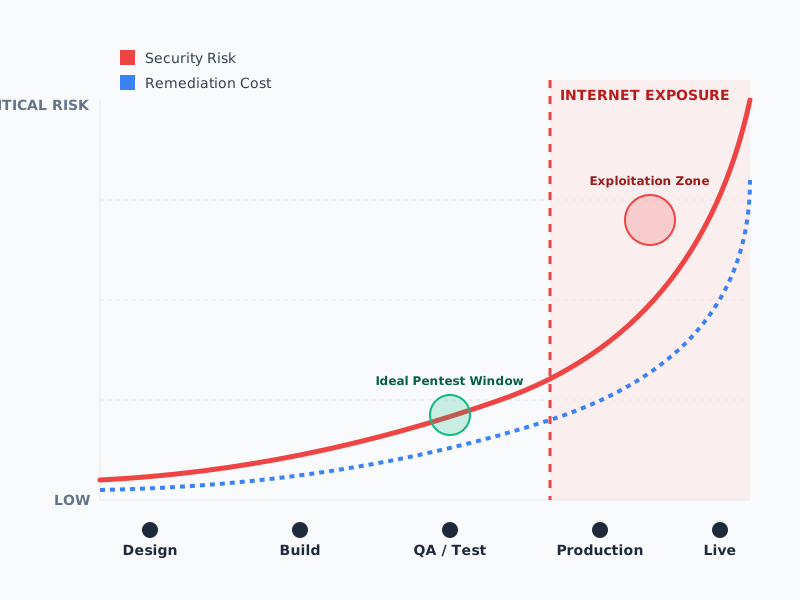 The 'Shift-Left' principle: Delaying penetration testing until after production exposure leads to exponentially higher costs and security risks.
Build the Foundation on Day One
The most critical takeaway from CVE-2026-3055 is that penetration testing is not a luxury reserved for unicorns and Fortune 500s. It is a foundational practice that must begin the moment your application is exposed to the public internet.
Here is how you build that foundation before your architecture becomes too complex to secure:
1. Baseline Testing at Launch
Before you onboard your first paying customer, conduct a baseline penetration test. This doesn't require a six-figure engagement. Focus on the core SaaS mechanics: tenant isolation, authentication, authorization (RBAC), and session management. If these are flawed on day one, they will be nearly impossible to untangle on day one thousand.
2. Map Business Logic Early
Automated scanners are excellent for catching misconfigurations, but they cannot understand your business logic. CVE-2026-3055 was a logic flaw. Human-led penetration testing must be utilized to map out how your application handles complex workflows, ensuring that users cannot manipulate state or access data outside their intended scope.
3. Iterative Testing Over "Big Bang" Engagements
Instead of waiting for an annual, massive penetration test, adopt an iterative approach. As you push major structural updates or expose new API versions to the internet, test those specific components. Continuous, smaller-scoped tests build a historical understanding of your application's security posture.
4. Treat Penetration Testing as Architectural Feedback
A penetration test should not just be a list of bugs to patch; it should be feedback on your system's architecture. If a tester finds a way to bypass tenant isolation, the solution is rarely just a localized patch. It requires a review of how your application handles identity at a systemic level.
The Real Cost of Waiting
CVE-2026-3055 proves that you cannot outspend a bad architectural foundation. Large corporations are learning the hard way that throwing money at complex SaaS penetration testing late in the game yields diminishing returns.
For SaaS founders, developers, and security leaders, the mandate is clear: start testing early. The moment your application touches the internet, it is a target. Building a habit of regular, foundational penetration testing from the very beginning is the only reliable way to ensure that when your company finally reaches enterprise scale, your security posture scales with it.