
By 2026, AI coding assistants have evolved from novel productivity boosters to foundational components of the software development lifecycle. But as our reliance on Large Language Models (LLMs) to generate boilerplate, optimize algorithms, and suggest libraries has grown, so has a highly deceptive vector in software supply chain attacks: the AI-hallucinated package.
Traditional dependency confusion relies on attackers guessing the names of internal, proprietary packages and registering them on public registries. Today, attackers don't have to guess. They are weaponizing the very AI tools developers use, turning LLM hallucinations into a delivery mechanism for malicious code.
The Phantom Dependency Problem
LLMs are inherently probabilistic. When a developer prompts an AI assistant with a highly specific or niche problem—such as parsing a proprietary data format or integrating two obscure APIs—the model wants to provide a clean, elegant solution. Occasionally, the AI will "hallucinate" a library that perfectly solves the problem, complete with a plausible-sounding name, fabricated documentation, and synthetic usage examples.
To the developer, a suggestion like pip install fastapi-auth-bridge or npm install react-query-sync-helper looks legitimate. The problem? The package doesn't exist.
Or rather, it didn't exist until an attacker noticed the trend.
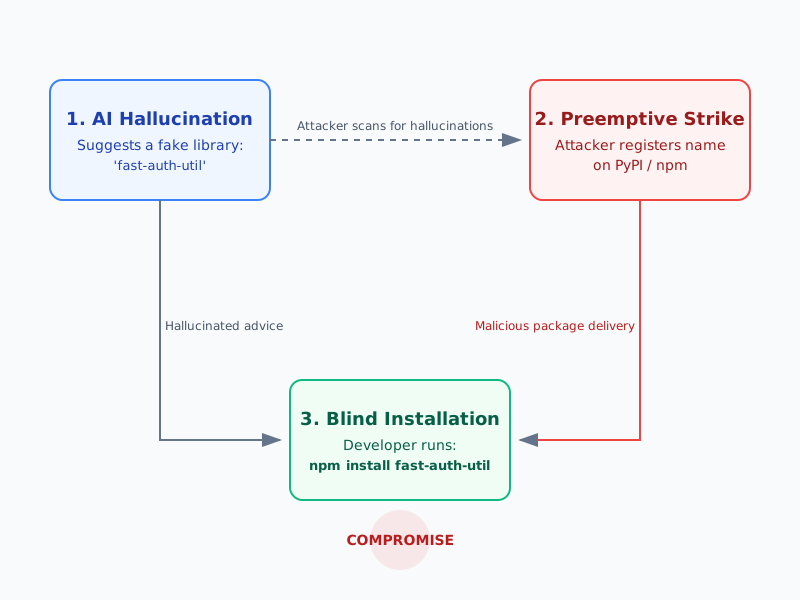 The attack lifecycle: From LLM hallucination to supply chain compromise.
How the Hallucination Attack Works
Threat actors have realized that popular LLMs often hallucinate the same fake package names for the same types of coding queries. The attack lifecycle is remarkably simple, yet devastatingly effective:
- Prompt Harvesting: Attackers continuously interact with popular coding LLMs, feeding them common programming challenges and edge cases to map out the fake libraries the models consistently hallucinate.
- Preemptive Registration: Once an attacker identifies a frequently hallucinated package name (e.g.,
crypto-utils-lite), they register that exact name on public registries like PyPI, npm, or RubyGems. - Weaponization: The attacker uploads a functional package that mimics the expected behavior outlined by the AI, but embeds a malicious payload—such as a reverse shell, credential stealer, or a backdoor into the CI/CD pipeline.
- Developer Execution: A developer asks their AI assistant for help, receives the hallucinated package suggestion, and blindly copies the installation command into their terminal.
Because the malicious package actually performs the function the AI promised, the developer remains completely unaware that their workstation—and potentially the broader software supply chain—has just been compromised.
The Attacker's Advantage
What makes AI-hallucinated package attacks so dangerous is the implicit trust developers place in their tooling. A developer might scrutinize a package they found on a random forum, but they are far more likely to bypass standard vetting processes when the recommendation comes directly from their integrated IDE assistant.
Furthermore, traditional Software Composition Analysis (SCA) tools often fail to catch these zero-day malicious packages immediately. Because the package is newly registered and hasn't yet been flagged in global vulnerability databases, it easily slips past automated security gates.
Mitigating the Threat of AI-Hallucinated Code
Securing your software supply chain against AI-driven dependency confusion requires a shift in both culture and tooling. Here is how modern engineering teams are defending their pipelines:
- Zero-Trust for AI Output: Treat all AI-generated code as untrusted third-party input. Developers must manually verify the existence, maturity, and maintainer reputation of any suggested package before installation.
- Shift-Left Package Vetting: Integrate dynamic SCA and reputation scoring directly into the IDE. Tools should instantly analyze
npm installorpip installcommands generated by AI, flagging packages that are less than 30 days old, have zero community traction, or lack a verifiable repository. - Private Registries and Strict Egress: Force all package installations to route through a secure internal proxy (like Artifactory or Nexus). Implement policies that block the download of newly published packages from public registries until they have undergone automated static analysis.
- Context-Aware AI Constraints: Utilize enterprise-grade AI coding assistants that are strictly grounded in your organization's approved dependency tree. By restricting the AI's context window to pre-vetted libraries, you eliminate the possibility of it hallucinating external packages.
Conclusion
AI coding assistants have fundamentally accelerated the speed of software development, but they have also accelerated the speed at which we can import risk. As threat actors continue to exploit the probabilistic nature of LLMs, the software supply chain requires more than just traditional vulnerability scanning.
Defending against Dependency Confusion 2.0 means recognizing that in the AI era, the call is coming from inside the IDE. Trust your assistants, but verify their dependencies.