The third week of April 2026 will likely be remembered as a watershed moment for software supply chain security. As development teams scramble to meet the newly enforced European Union Cyber Resilience Act (CRA) deadlines, threat actors are deploying increasingly sophisticated, automated exploits designed to bypass traditional static analysis.
From the emergence of "Ghost Commit" attacks to evasive polyglot packages, the gap between compliance and actual security has never been more apparent. Here is a breakdown of the critical supply chain security updates you need to know this week.
SpectrePipeline and the Rise of "Ghost Commits"
Between April 16 and April 23, cybersecurity telemetry recorded a massive spike in activity from a newly discovered automated exploit framework known as SpectrePipeline.
Unlike traditional malware that targets application code, SpectrePipeline directly attacks OpenID Connect (OIDC) trust relationships within cloud-native CI/CD environments. By compromising these multi-factor pipeline gates, the framework facilitates what researchers are calling "Ghost Commit" attacks. In a Ghost Commit scenario, malicious code is injected directly into ephemeral CI/CD runners and wiped completely before traditional logging mechanisms can capture the telemetry.
"SpectrePipeline represents the first time we've seen AI-driven agents successfully navigate multi-factor pipeline gates without human intervention, marking a new era of autonomous supply chain threats." — CyberEdge Daily
Because the runner environments are ephemeral, forensic analysis after the fact is nearly impossible without advanced runtime monitoring in place.
EU CRA Enforcement: The VEX Pivot
This surge in sophisticated supply chain threats coincides with a monumental regulatory milestone: the April 20, 2026, enforcement deadline for the EU Cyber Resilience Act (CRA).
The CRA's strict "Attestation of Integrity" requirements have forced a massive industry pivot away from static Software Bill of Materials (SBOMs) toward automated VEX (Vulnerability Exploitability eXchange) integrations. Static SBOMs are no longer sufficient to prove that a vulnerability is unexploitable in a specific runtime context.
"With the EU CRA enforcement now live as of April 20th, the gap between static SBOMs and real-time exploitability (VEX) has moved from a technical hurdle to a significant legal liability for global software vendors." — Global Security Review
Alarmingly, research published just a day after the deadline indicates that 65% of open-source projects are currently non-compliant with the new CRA requirements. This widespread non-compliance has triggered a massive surge in "Compliance-as-Code" tooling as organizations race to automate their attestation pipelines and avoid hefty regulatory penalties.
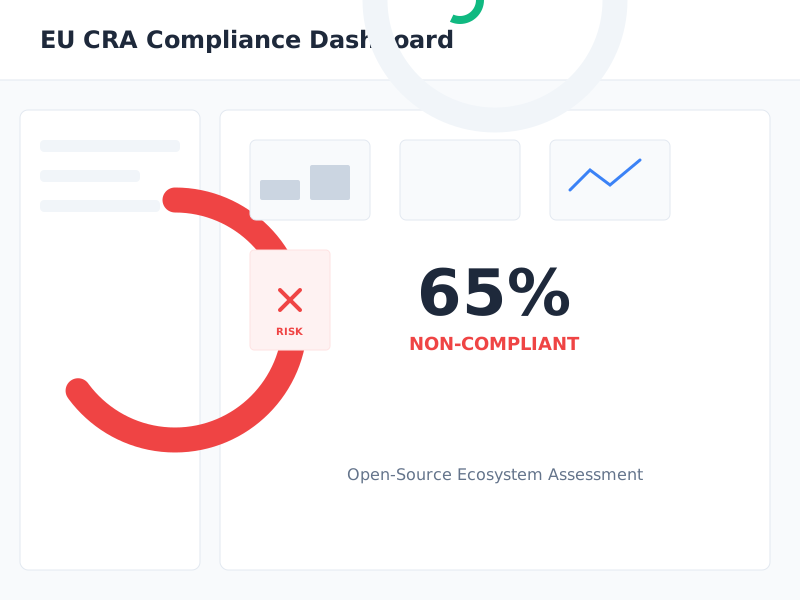 Recent analysis suggests up to 65% of open-source projects currently fall short of the technical requirements mandated by the EU Cyber Resilience Act (CRA).
Polyglot Malicious Packages Evade Static Scanners
Complicating the CRA compliance push is the discovery of new "Polyglot Malicious Packages" in the wild. These packages are specifically designed to defeat the static SBOM scanners that organizations are currently relying on for basic compliance.
These polyglot packages are environment-aware. When they are pulled into a CI/CD pipeline, they actively scan their surroundings. If they detect a security sandbox or an analysis environment, they remain dormant or execute benign code. However, if they detect a production CI/CD runner, they execute their malicious payloads.
By shifting their behavior based on the execution environment, these packages successfully bypass traditional static analysis, reinforcing the urgent need for dynamic, runtime-aware security measures.
Moving Forward
The convergence of SpectrePipeline's automated CI/CD exploitation, evasive polyglot packages, and strict new EU CRA mandates paints a clear picture: the days of relying on static, point-in-time security checks are over. Securing the modern software supply chain now requires continuous runtime visibility, automated VEX integration, and a zero-trust approach to ephemeral pipeline environments.