GitOps has officially won the deployment war. By 2026, the paradigm of using Git as the single source of truth for declarative infrastructure and applications is the de facto standard for cloud-native teams. Tools like Argo CD and Flux have transformed how we manage Kubernetes clusters, offering self-healing environments and rapid, automated rollouts.
But this automation comes with a dark side. When you wire your production clusters to automatically synchronize with a Git repository, you are creating a high-speed highway straight into your infrastructure. If an attacker manages to poison that repository, GitOps stops being a deployment mechanism and instantly becomes an automated attack distribution system.
Here is why the "GitOps Trap" is becoming a primary vector for supply chain attacks, and how you can secure your automated deployments before they turn against you.
The Double-Edged Sword of Continuous Sync
Traditional CI/CD pipelines rely on a "push" model. A build server compiles code, runs tests, and pushes the final artifact to production. This model had its flaws—primarily that the CI server needed god-level credentials to the production environment.
GitOps flipped the script with a "pull" model. A software agent sits inside your secure cluster, constantly monitoring a Git repository. When it detects a change in the declarative configuration, it automatically pulls the changes and updates the cluster to match the new state.
From a network security perspective, this is brilliant. Your cluster doesn't need to expose ingress ports to a CI server. However, from a supply chain security perspective, it creates a massive blind spot: the in-cluster agent implicitly trusts the Git repository. If an attacker alters the configuration in Git, the cluster will obediently deploy the malware, often bypassing traditional runtime security checks.
Anatomy of a GitOps Supply Chain Attack
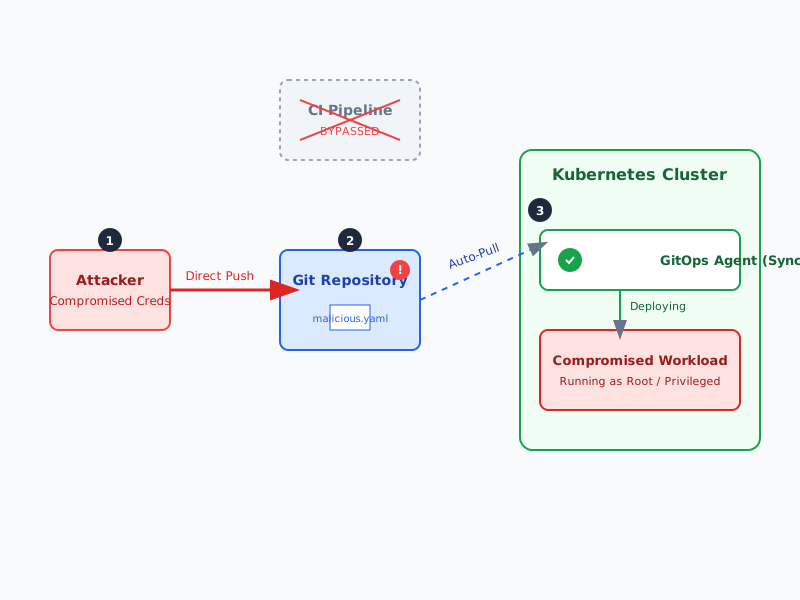 In a GitOps environment, compromising the source of truth allows attackers to bypass CI gates and deploy malicious workloads directly to production.
Attackers have realized that they don't need to break into your Kubernetes cluster directly. They just need to manipulate the instructions your cluster is programmed to follow. This typically happens through three primary vectors:
1. The Compromised Manifest
If an attacker compromises a developer's credentials or a weakly secured service account, they can push a malicious YAML manifest directly to the configuration repository. This could be as simple as changing an image tag from myapp:1.4.2 to myapp:1.4.2-malicious, or adding a cryptominer as a sidecar container. Because the GitOps agent is designed to reconcile state automatically, the malicious payload is deployed within seconds.
2. Automated PR Poisoning
Many teams use automated bots (like Dependabot or Renovate) to keep dependencies up to date. Attackers are increasingly using techniques like dependency confusion or semantic squatting to publish malicious packages. When the bot automatically generates a Pull Request to update the dependency, and a hurried developer (or an automated auto-merge policy) approves it, the GitOps pipeline blindly pulls the poisoned update into production.
3. Image Tag Hijacking
Some GitOps setups are configured to monitor container registries for new images and automatically update the Git repository when a new image is pushed. If an attacker compromises your container registry and pushes a malicious image using an existing tag (like latest or a floating minor version tag), the GitOps loop will pull the compromised image into the cluster without a single line of code changing in the primary application repository.
Securing the GitOps Pipeline
To safely leverage the speed of GitOps without falling into the trap, organizations must shift from implicit trust to cryptographic verification.
Enforce Commit Signing
Your GitOps agent should not trust a commit just because it exists in the main branch. Enforce cryptographic signing for all commits (using GPG, SSH, or Sigstore's gitsign). Configure your Git provider to reject unsigned commits, ensuring that every configuration change is cryptographically tied to a verified human or machine identity.
Implement Admission Controllers
Do not rely solely on the GitOps agent for security. Implement Kubernetes admission controllers like Kyverno or OPA Gatekeeper to act as a final line of defense. These controllers can evaluate incoming resources and block deployments that violate security policies—such as pulling images from untrusted registries or running containers as root—even if the GitOps agent requests them.
Verify Image Signatures
Before your cluster runs any container image, it must verify its provenance. Integrate tools like Cosign (part of the Sigstore project) to cryptographically verify container image signatures and Software Bills of Materials (SBOMs) at deployment time. If an image tag is hijacked, the signature verification will fail, and the admission controller will block the deployment.
Require Two-Person Reviews for Infrastructure Changes
Automation should not bypass human governance for critical infrastructure. Enforce strict branch protection rules on your GitOps repositories that require at least two approved reviews from authorized personnel before a PR can be merged. Disable auto-merge for infrastructure repositories entirely.
Conclusion
GitOps is a powerful methodology that dramatically improves deployment speed and reliability. However, treating a Git repository as an infallible single source of truth is a dangerous game in today's threat landscape.
By layering cryptographic verification, strict access controls, and runtime admission policies over your GitOps workflows, you can ensure that your automated deployments remain a tool for innovation, rather than a weapon for attackers.