
When we think of software supply chain attacks, our minds immediately jump to compromised dependencies, poisoned CI/CD pipelines, and misconfigured package managers. We picture highly technical exploits—a rogue script injected into a popular NPM package or a compromised build server signing malicious binaries.
But as technical perimeters have hardened and SBOMs (Software Bill of Materials) have become standard practice, advanced persistent threats (APTs) have pivoted. Why spend months trying to crack a hardened CI/CD pipeline when you can simply ask for the keys?
Welcome to the era of the "Long Con"—where social engineering is no longer about quick phishing clicks, but about multi-year operations to infiltrate the open-source and enterprise software supply chains at the human level.
The XZ Utils Watershed Moment
To understand the threat landscape of 2026, we have to look back at the watershed moment of early 2024: the XZ Utils backdoor. A threat actor operating under the pseudonym "Jia Tan" didn't hack a server or exploit a vulnerability to insert malicious code. Instead, they spent two years building a reputation, submitting helpful pull requests, and gaining the trust of a burned-out sole maintainer.
Once they were handed the reins, they quietly slipped a highly sophisticated, obfuscated backdoor into the SSH authentication flow. It was a masterpiece of social engineering that nearly compromised millions of Linux machines globally.
Since then, this tactic has been operationalized at scale. Attackers realized that the open-source ecosystem, built entirely on trust and volunteer labor, is the softest underbelly of the modern enterprise.
The Anatomy of a Supply Chain Long Con
Today's supply chain social engineering attacks are methodical, well-funded, and terrifyingly patient. They typically follow a distinct four-phase lifecycle:
 The four distinct phases of a sophisticated long-con social engineering attack.
Phase 1: Persona Cultivation
Attackers create fabricated digital identities complete with GitHub activity, LinkedIn profiles, and even fake employment histories at defunct startups. They use generative AI to maintain consistent communication styles, language patterns, and coding habits.
Phase 2: The "Helpful Contributor"
The persona targets a critical but under-resourced project. They start small: fixing typos, updating documentation, and resolving minor bugs. Over months, they become a reliable fixture in the community. They are unfailingly polite, highly responsive, and technically competent.
Phase 3: The Handoff
Open-source maintainer burnout is an epidemic. When a maintainer expresses exhaustion, the attacker steps in, offering to take over release management or core maintenance duties. The exhausted maintainer, relieved to have competent help, hands over commit rights and publishing credentials.
Phase 4: The Payload
The compromise doesn't happen immediately. The attacker waits for a major release. They introduce the backdoor under the guise of an "optimization," "refactoring," or complex test file. Because they are now a trusted core maintainer, peer review is either bypassed or rubber-stamped.
Why Traditional Security Fails
Our current security tooling is completely blind to the Long Con.
- SAST and DAST scanners look for known vulnerabilities (CVEs) or common coding flaws like SQL injection. They struggle to identify highly obfuscated, logic-based backdoors hidden in test binaries.
- SCA (Software Composition Analysis) tools alert you when a dependency is outdated or has a known CVE, but they assume the latest version published by a trusted maintainer is safe.
- Code signing only proves that the code came from the maintainer's machine—it doesn't prove the maintainer's intentions.
When the threat actor is the authorized developer, technical guardrails fall apart.
Defending the Human Perimeter
Protecting your organization against the Long Con requires a fundamental shift in how we view supply chain security. We must move beyond purely technical checks and introduce Zero Trust principles to human behavior.
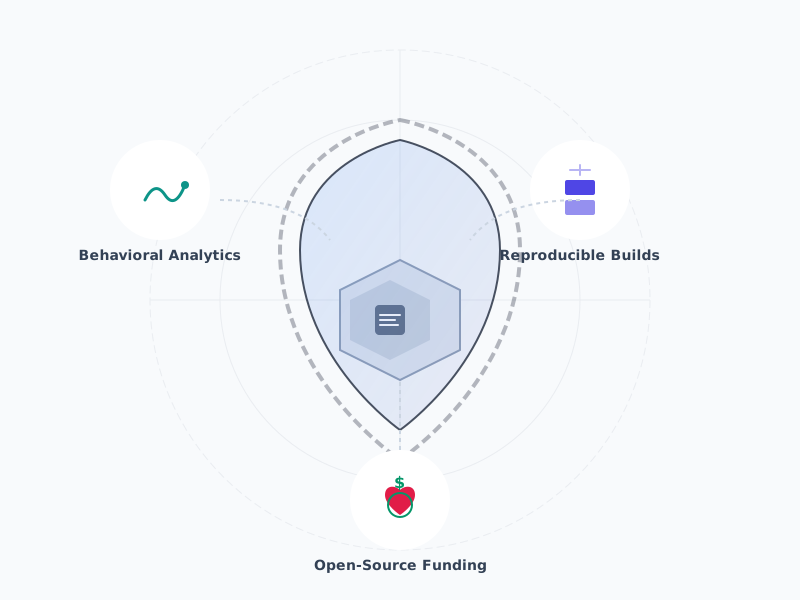 A holistic defense strategy for developer ecosystems relies on behavioral insights, technical integrity, and sustainable financial support.
1. Behavioral Analytics for Identity
We are seeing the rise of developer behavioral analytics. Security teams are starting to monitor for sudden shifts in a contributor's habits. Does a developer who usually codes in Python suddenly submit a highly complex C-level optimization? Do their commit times drastically shift time zones? These anomalies can trigger mandatory, deeper code reviews.
2. Reproducible Builds and Verifiable Provenance
Enterprises must demand reproducible builds—where source code compiled twice yields the exact same binary. This prevents attackers from modifying the release tarball directly (as seen in the XZ hack) without the changes being visible in the public source code repository.
3. Funding the Open Source Ecosystem
Ultimately, the root cause of the Long Con is maintainer burnout. Threat actors prey on the fact that critical infrastructure is maintained by unpaid volunteers working nights and weekends. Enterprises must financially support the dependencies they rely on. Paying for maintenance, security audits, and dedicated support directly reduces the vulnerability of these projects to hostile takeovers.
The Ultimate Vulnerability
As we push into the late 2020s, the hardest truth in cybersecurity remains unchanged: the human mind is the ultimate zero-day.
We can build the most secure CI/CD pipelines in the world, enforce strict cryptographic signing, and mandate SBOMs for every microservice. But as long as we blindly trust the identities behind the code, the Long Con will continue to be the most devastating weapon in the supply chain attacker's arsenal.