
If you ask a CISO in 2026 what keeps them up at night, it isn't just a phishing email targeting an intern. It's a stale API key, an over-privileged service account, or a forgotten OAuth token.
Welcome to the era of Non-Human Identities (NHIs).
As organizations embrace complex cloud-native architectures, autonomous AI agents, and hyper-automated CI/CD pipelines, the ratio of machine identities to human identities has skyrocketed. While human users are protected by strict Multi-Factor Authentication (MFA) and biometric verifications, machine identities often rely on static secrets that are shockingly easy to exploit.
Here is why non-human identities have become the most vulnerable attack surface in the modern software supply chain—and how you can secure them.
The Scale of the Machine Identity Crisis
For every developer in your organization, there are likely dozens—if not hundreds—of machine identities. These include:
- Service Accounts: Used by applications to interact with cloud environments.
- API Keys and Tokens: Facilitating communication between microservices, third-party SaaS tools, and internal databases.
- CI/CD Pipeline Credentials: Allowing automation servers to pull code, build artifacts, and deploy infrastructure.
- AI Agent Credentials: Tokens granted to autonomous systems to execute tasks across your environment.
The sheer volume of these identities creates a massive blind spot. Traditional Identity and Access Management (IAM) solutions were built for humans. They struggle to map, monitor, and manage the ephemeral, highly distributed nature of machine identities.
Why CI/CD Pipelines are Ground Zero
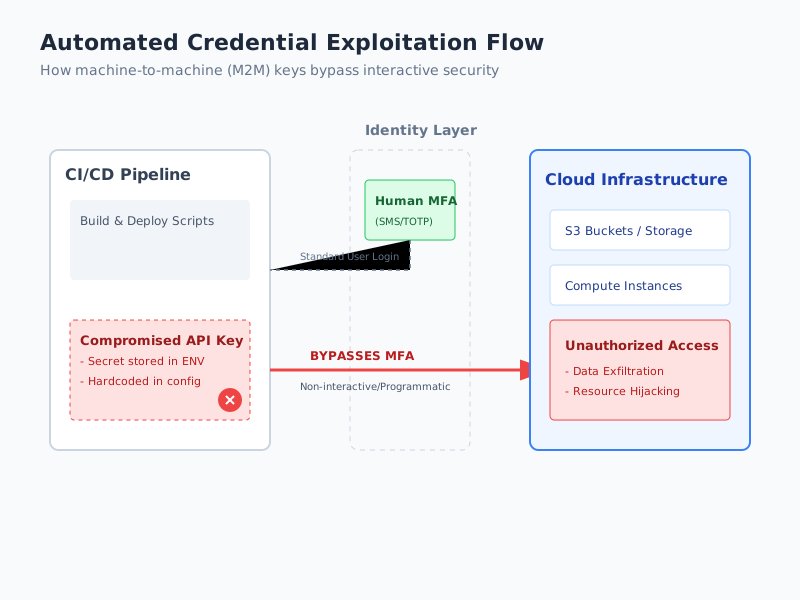 Machine-to-machine (M2M) credentials create a blind spot in security: they often bypass traditional MFA designed for human users, making compromised CI/CD keys a high-value target for attackers.
The software supply chain runs on automation, making CI/CD pipelines a goldmine for attackers seeking machine credentials.
When an attacker compromises a human developer, they are often restricted by role-based access controls (RBAC) and conditional access policies. However, if an attacker successfully extracts a service account token from a compromised build environment, they effectively achieve "God mode."
Build agents require extensive permissions to do their jobs. They need to push to artifact registries, provision cloud infrastructure via Infrastructure as Code (IaC), and access production databases. A compromised pipeline credential bypasses traditional human-centric defenses entirely, allowing threat actors to inject malicious code, exfiltrate data, or pivot laterally across the network.
Critical Vulnerabilities in NHI Management
Securing machine identities requires understanding how they are typically mishandled:
- Secret Sprawl: Hardcoded credentials in source code, configuration files, or chat logs remain a pervasive issue. Even with secret-scanning tools, sophisticated attackers can piece together fragmented credentials from build logs.
- Over-Privileging: To prevent pipeline breakages, DevOps teams often grant service accounts broad, permissive roles rather than adhering to the principle of least privilege.
- Lack of Lifecycle Management: When an employee leaves, their access is revoked. When a microservice is deprecated, its associated API keys and service accounts are frequently left active—creating "zombie" identities that attackers love to exploit.
Defending the Machine Perimeter
To secure the software supply chain against NHI exploitation, security teams must adopt a machine-first approach to identity management.
- Comprehensive Discovery and Inventory: You cannot protect what you cannot see. Implement automated tools to continuously discover and map all non-human identities across your cloud environments, SaaS applications, and code repositories.
- Transition to Ephemeral Credentials: Move away from static, long-lived API keys. Implement Just-In-Time (JIT) access and short-lived, dynamically generated tokens for machine-to-machine communication.
- Behavioral Anomaly Detection: Machine identities typically exhibit highly predictable behavior. A CI/CD service account should only access specific repositories during designated build times. Any deviation—such as an API key attempting to access a database from a foreign IP address—should trigger an immediate automated response.
- Strict Least Privilege: Regularly audit machine permissions. Use automated tools to analyze access patterns and right-size permissions based on what the machine identity actually uses, rather than what it was initially granted.
Conclusion
The perimeter has shifted. As long as software supply chains rely on automation, non-human identities will remain a primary target for sophisticated threat actors. By treating machine identities with the same—if not greater—scrutiny as human users, organizations can close this critical security gap and build truly resilient development pipelines.