Despite the ubiquitous adoption of Object-Relational Mappers (ORMs) and modern web frameworks, SQL Injection (SQLi) remains a persistent threat in the application security landscape. When developers bypass ORMs for complex queries or misuse string interpolation, they inadvertently expose their databases to total compromise.
This post dives into the technical mechanics of SQLi, demonstrating how modern backends built with Python and Node.js (NPM) can fall victim to these attacks, and how to architect bulletproof defenses.
The Mechanics of SQL Injection
At its core, a SQL injection occurs when untrusted user input alters the Abstract Syntax Tree (AST) of a SQL statement parsed by the database engine. Instead of treating the input as a literal value, the database interprets it as an executable command.
Consider a classic authentication bypass payload: ' OR 1=1 --. When injected into a poorly constructed query, the payload forces the WHERE clause to evaluate to true for every row, and the -- comments out the remainder of the intended query logic.
Let's look at how this manifests in modern development environments.
Python: The F-String Trap
Python's f-strings are incredibly ergonomic for string formatting, but they are a massive security liability when used to construct SQL queries.
Vulnerable Implementation
Using the standard sqlite3 library (or psycopg2 for PostgreSQL), a developer might write:
python import sqlite3
def get_user_data(username: str): conn = sqlite3.connect('production.db') cursor = conn.cursor()
# DANGEROUS: F-string allows AST manipulation
query = f"SELECT id, email, role FROM users WHERE username = '{username}'"

cursor.execute(query)
return cursor.fetchall()
If an attacker passes admin' -- as the username, the executed query becomes SELECT id, email, role FROM users WHERE username = 'admin' --', effectively bypassing any password checks that might have followed.
Secure Implementation
The definitive fix is to use parameterized queries (also known as prepared statements). This forces the database driver to send the SQL structure and the data payload separately, ensuring the AST cannot be modified.
python import sqlite3
def get_user_data_secure(username: str): conn = sqlite3.connect('production.db') cursor = conn.cursor()
# SECURE: The driver handles escaping and parameter binding
query = "SELECT id, email, role FROM users WHERE username = ?"

cursor.execute(query, (username,))
return cursor.fetchall()
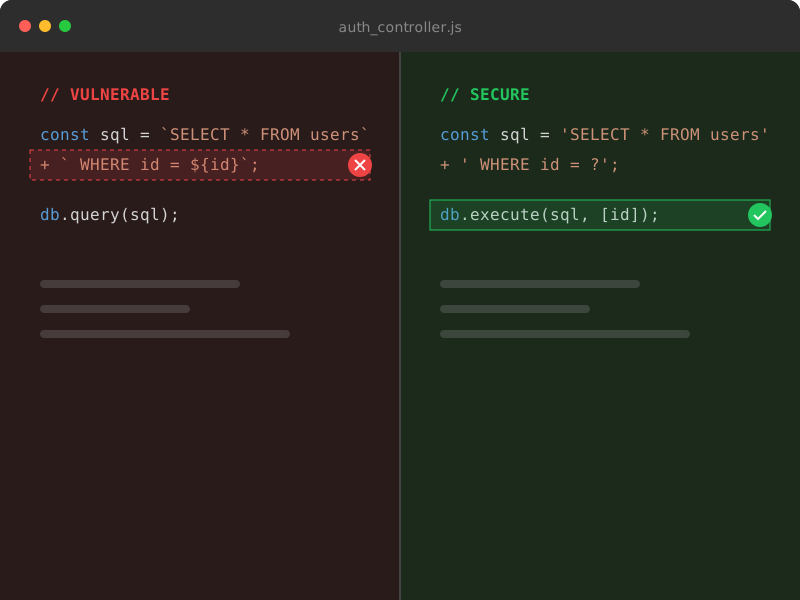 Parameterized queries (right) prevent common vulnerabilities like SQL injection (left).
Node.js and NPM: Template Literal Pitfalls
In the JavaScript/TypeScript ecosystem, template literals (${}) present the exact same risk as Python's f-strings. Even when using popular NPM packages like pg (node-postgres) or mysql2, raw string concatenation is a fatal error.
Vulnerable Implementation
Here is an example using the popular pg package:
javascript const { Client } = require('pg');
async function getUserData(username) { const client = new Client(); await client.connect();
// DANGEROUS: Template literal injection
const query = SELECT id, email, role FROM users WHERE username = '${username}';
try { const res = await client.query(query); return res.rows; } finally { await client.end(); } }
Secure Implementation
The pg package natively supports parameterized queries. By passing an array of values as the second argument to client.query(), we neutralize the injection vector.
javascript const { Client } = require('pg');
async function getUserDataSecure(username) { const client = new Client(); await client.connect();
// SECURE: Parameterized query using $1, $2, etc. const query = 'SELECT id, email, role FROM users WHERE username = $1';
try { const res = await client.query(query, [username]); return res.rows; } finally { await client.end(); } }
The ORM Illusion: Raw Queries in Prisma and SQLAlchemy
A common misconception is that using an ORM automatically protects you from SQLi. While true for standard ORM methods (e.g., prisma.user.findUnique() or session.query(User)), developers often resort to "raw queries" for performance tuning or complex joins.
If you use prisma.$queryRawUnsafe() in Node.js or text() in SQLAlchemy (Python) with unparameterized strings, you are reintroducing the exact same vulnerability. Always use the safe raw query alternatives provided by your ORM, such as prisma.$queryRaw (which utilizes tagged template literals for parameterization) or SQLAlchemy's bindparams.
Defense in Depth
While parameterized queries are the silver bullet for SQLi, a robust DevSecOps posture requires defense in depth:
- Principle of Least Privilege (PoLP): The database user utilized by your application should only have the permissions necessary to function. It should not have
DROP TABLErights or access to system schemas. - Input Validation: Validate input types, lengths, and formats at the API gateway or controller level before it ever reaches the database layer.
- Static Application Security Testing (SAST): Integrate tools like Semgrep or CodeQL into your CI/CD pipeline to automatically flag dangerous string concatenation in database execution sinks.
SQL injection is a solved problem at the protocol level, but it requires disciplined coding practices to eradicate at the application level.