In the modern software development lifecycle, humans are no longer the primary actors. Behind every developer pushing code, there is an invisible army of automated scripts, CI/CD runners, deployment bots, and microservices communicating with one another. These are Non-Human Identities (NHIs), and by 2026, they outnumber human developers by a staggering margin.
While organizations have spent millions securing human identities with biometric MFA, conditional access, and zero-trust frameworks, the machine-to-machine (M2M) ecosystem has largely been left to govern itself. The result? A sprawling, unmanaged web of long-lived API keys, OAuth tokens, and overly permissive service accounts that has become the primary vector for software supply chain attacks.

The Anatomy of an NHI Supply Chain Attack
Unlike human credentials, non-human identities cannot be phished. However, they don't need to be. Attackers have realized that compromising a single service account often yields a much higher return on investment than compromising a human developer.
Consider a typical attack path:
- The Forgotten Secret: A developer creates a temporary Personal Access Token (PAT) to allow a third-party logging integration to pull data from a repository. The integration is abandoned, but the token is never revoked.
- The Initial Breach: Attackers compromise the third-party vendor and harvest the stale PAT.
- The Pivot: Because the token was created with overly broad scopes (a common practice to "just get it working"), the attackers use it to access the organization's internal CI/CD pipeline.
- The Supply Chain Poisoning: Bypassing all human MFA prompts, the attackers inject malicious deployment scripts into a trusted build process, poisoning the final software artifact distributed to customers.
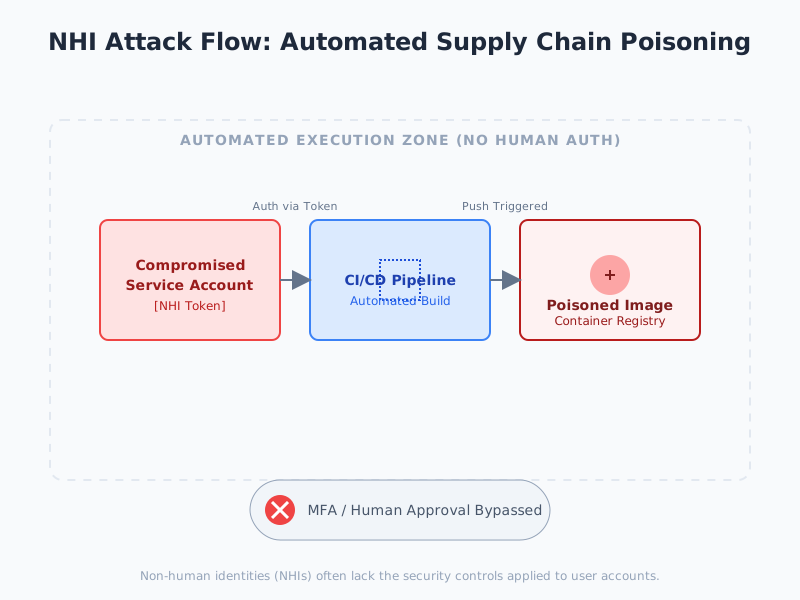 How attackers exploit the lack of human intervention in NHI-driven workflows to compromise the software supply chain.
Why Legacy IAM Fails the Supply Chain
Traditional Identity and Access Management (IAM) tools were built for humans. They assume an identity logs in from a specific geographic location, during specific hours, and can respond to an MFA prompt on a smartphone.
NHIs break all of these assumptions. A CI/CD runner operates 24/7, authenticates from ephemeral IP addresses, and requires programmatic access. Consequently, security teams often grant these identities perpetual access with static credentials to avoid breaking critical pipelines. This "set it and forget it" mentality leads to NHI Sprawl—a state where security teams have no accurate inventory of how many machine identities exist, what they have access to, or who owns them.
Securing the Machine-to-Machine Perimeter
Securing the software supply chain today requires treating machine identities as Tier-0 assets. Here is how forward-thinking engineering teams are mitigating NHI sprawl:
1. Shift to Ephemeral Credentials (OIDC)
Static credentials are a ticking time bomb. Organizations must transition away from long-lived API keys and PATs. By leveraging OpenID Connect (OIDC), CI/CD pipelines can request short-lived, just-in-time access tokens from cloud providers. Once the deployment job finishes, the token expires, leaving attackers with nothing to steal.
2. Implement Continuous NHI Discovery
You cannot secure what you cannot see. Security teams must deploy automated discovery tools that map the entire M2M ecosystem. This involves scanning source code, CI/CD configurations, and cloud environments to build a dynamic inventory of every active service account, webhook, and OAuth integration.
3. Enforce Cryptographic Attestation
To prevent an attacker from abusing a stolen machine identity to push malicious code, pipelines must enforce cryptographic attestation. Frameworks like SLSA (Supply chain Levels for Software Artifacts) ensure that every step of the build process is cryptographically signed. If a rogue NHI attempts to bypass a step or inject unverified code, the attestation fails, and the deployment is blocked.
4. Apply Behavioral Anomaly Detection
Because NHIs perform highly repetitive, deterministic tasks, they are prime candidates for behavioral baseline monitoring. If a deployment bot that typically only interacts with an AWS S3 bucket suddenly attempts to clone a proprietary GitHub repository, automated guardrails should instantly revoke its access.
Conclusion
In 2026, the software supply chain is driven by machines talking to machines. As long as Non-Human Identities remain under-managed and over-privileged, they will serve as the path of least resistance for attackers. Securing the modern development pipeline requires a fundamental shift: we must scrutinize the identities of our automated systems with the exact same rigor we apply to our human developers.