While much of the security industry has spent the last few years obsessing over software bills of materials (SBOMs) and AI-generated code vulnerabilities, a quieter, more devastating threat has matured: Pipeline Privilege Escalation.
In 2026, your Continuous Integration and Continuous Deployment (CI/CD) pipeline is no longer just a delivery mechanism. It is the ultimate insider threat. Attackers have realized that they don't need to find a zero-day in your production application if they can simply hijack the automated systems you trust to deploy it.
Here is why CI/CD pipelines have become the attacker's playground, and how you can lock down your deployment factory before it turns against you.
The Ultimate Supply Chain Target
Modern development relies heavily on automation. We use GitHub Actions, GitLab CI, and Jenkins to test code, build containers, and deploy infrastructure. To do this, these pipelines are granted immense power. They hold cloud provider credentials, database passwords, and cryptographic signing keys.
When a pipeline is compromised, the attacker bypasses the traditional network perimeter entirely. They don't need to crack your Web Application Firewall (WAF) or bypass your API gateway. They just slip their malicious payload into a seemingly benign pull request, let your automated runners build it, and watch as your own infrastructure deploys the malware directly into production.
How Pipeline Escalation Happens
Attackers exploit the implicit trust placed in automated workflows. Here are the three most common vectors we are seeing exploited today:
1. Toxic Pull Requests (Pwn Requests)
Many organizations configure their CI/CD systems to automatically run tests whenever a new Pull Request is opened. If the pipeline is misconfigured to execute untrusted code from public forks without manual approval, an attacker can submit a PR containing a malicious build script. The runner executes the script, granting the attacker a foothold in the build environment.
2. Over-Permissive Self-Hosted Runners
To save money or access internal networks, many engineering teams deploy self-hosted runners on cloud compute instances. Often, these runners are granted overly broad IAM roles (e.g., AdministratorAccess) and are not destroyed after a single job. An attacker who compromises one job can leave behind a backdoor, persisting across subsequent builds and stealing secrets from other projects.
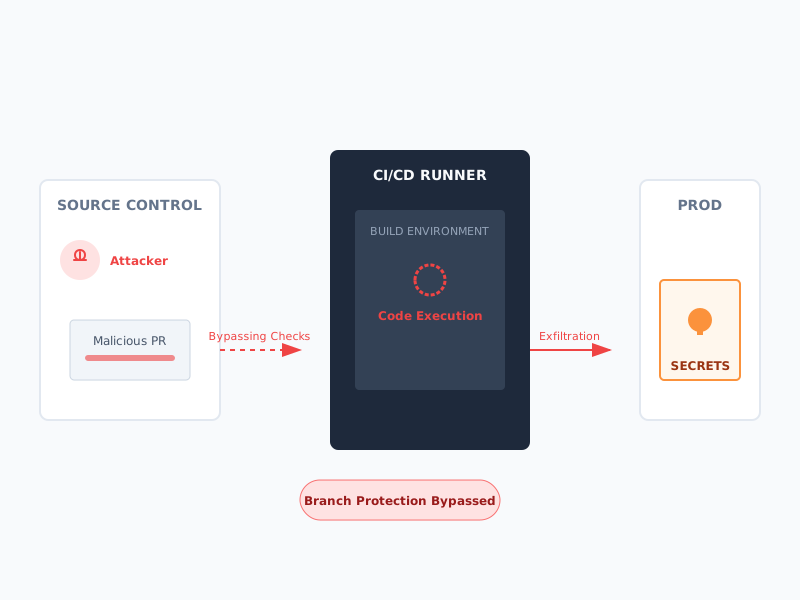 The lifecycle of a CI/CD compromise: from malicious pull request to production secret exfiltration.
3. Environment Variable Poisoning
Pipelines rely heavily on environment variables for configuration. If an attacker can inject or modify these variables—perhaps by compromising a developer's machine or exploiting a poorly scoped personal access token (PAT)—they can redirect build artifacts, alter deployment targets, or exfiltrate injected secrets to an external server.
Defending the Deployment Factory
Securing your CI/CD pipeline requires a shift in mindset: treat your pipeline as production infrastructure.
- Enforce Ephemeral Environments: Never reuse runners. Every CI/CD job should run in a clean, ephemeral container or virtual machine that is immediately destroyed upon completion. This prevents cross-job contamination.
- Implement the Principle of Least Privilege: Scope pipeline credentials tightly. Use OpenID Connect (OIDC) to grant short-lived, tightly scoped access tokens to cloud resources instead of storing long-lived static credentials in your repository secrets.
- Require Manual Approvals for External Code: Ensure that workflows triggered by external contributors require a manual review and approval from a core team member before any automated scripts are executed.
- Audit Third-Party Actions: Treat third-party CI/CD plugins (like GitHub Actions from the marketplace) as third-party software dependencies. Pin them to specific commit SHAs rather than mutable tags (like
@v1) to prevent upstream supply chain poisoning.
Conclusion
As we navigate the complex threat landscape of 2026, defending the application code is only half the battle. If your deployment pipeline is porous, your production environment is already compromised. By treating your CI/CD infrastructure with the same rigor as your production servers, you can close the door on pipeline privilege escalation and secure the heart of your software supply chain.