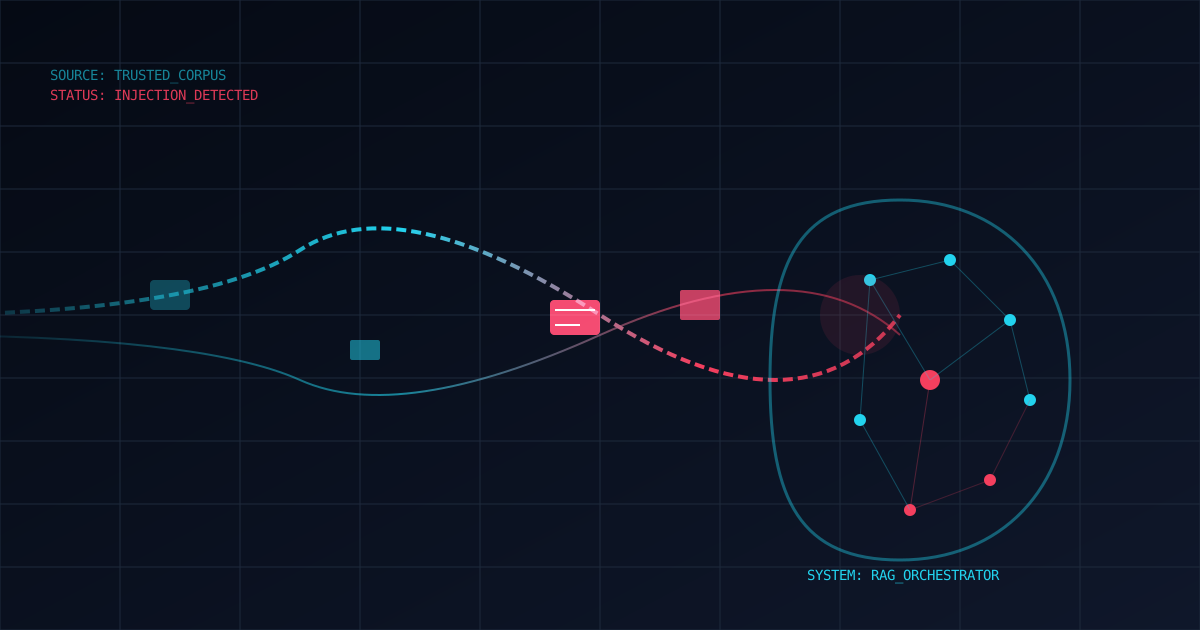
For years, the cybersecurity industry defined "supply chain attacks" through the lens of compromised code. We worried about malicious NPM packages, hijacked CI/CD pipelines, and vulnerabilities buried deep within open-source libraries. But as we navigate 2026, the architecture of enterprise software has fundamentally shifted. Software is no longer just deterministic code; it is driven by autonomous AI agents and dynamic data ingestion.
This paradigm shift has birthed a new, insidious threat vector: the convergence of Shadow Agents and RAG (Retrieval-Augmented Generation) Poisoning. Together, they are redefining what a supply chain attack looks like, targeting data dependencies rather than code dependencies.
The Evolution of Shadow IT: Enter the Shadow Agent
We are all familiar with Shadow IT—the unsanctioned SaaS apps and cloud instances spun up by employees trying to bypass sluggish procurement processes. In the AI era, this behavior has evolved into the deployment of Shadow Agents.
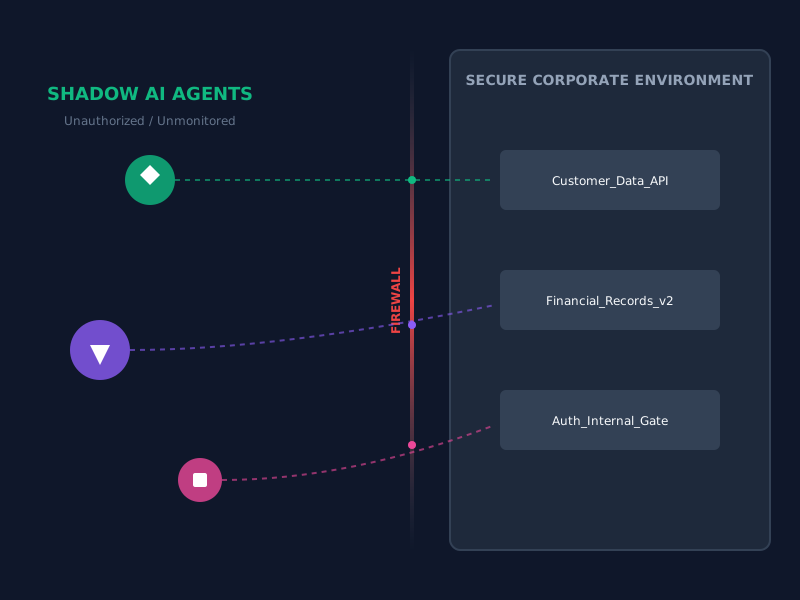 Shadow AI agents operate outside corporate oversight, often interacting directly with sensitive internal APIs without security vetting.
Unlike passive SaaS tools, AI agents have agency. They are granted permissions to read emails, scrape competitor websites, summarize Slack channels, and even execute code or trigger API workflows. When developers, marketers, or sales teams deploy undocumented, self-built, or third-party autonomous agents to automate their tasks, they create a massive blind spot for security teams.
These Shadow Agents operate outside the purview of traditional Identity and Access Management (IAM) and Data Loss Prevention (DLP) controls. They are highly privileged, deeply integrated, and entirely unmonitored.
RAG Poisoning: Contaminating the Well
To make AI agents useful, enterprises use Retrieval-Augmented Generation (RAG). RAG systems allow Large Language Models (LLMs) to pull context from external data sources—like internal wikis, customer support tickets, and third-party data feeds—before generating a response or taking action.
RAG Poisoning occurs when an attacker intentionally injects malicious data into the sources that a RAG system retrieves from.
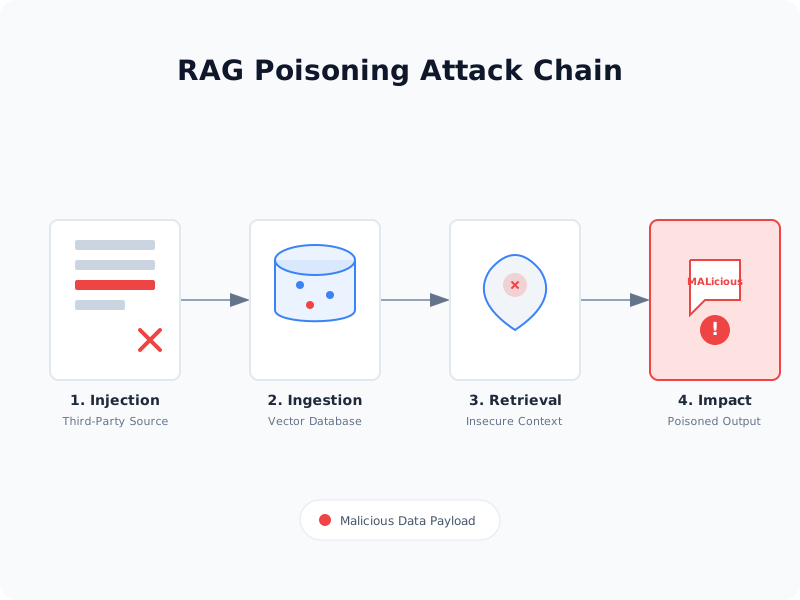 The RAG Poisoning Attack Chain: How malicious data flows from external sources through the retrieval pipeline to compromise LLM outputs.
Imagine an attacker compromising a low-tier vendor's documentation portal or a public GitHub repository that your enterprise ingests for market research. The attacker hides an invisible, malicious prompt within the text (an indirect prompt injection). When your internal AI agent retrieves that document, it ingests the hidden instructions.
Instead of just returning a summary, the poisoned data might instruct the agent to:
- Exfiltrate the user's session tokens to an external server.
- Alter its output to recommend a malicious software package to a developer.
- Delete files or modify configurations via its API access.
The Supply Chain Collision
When you combine Shadow Agents with RAG Poisoning, you get a devastating supply chain attack.
The "supply chain" is no longer just the software vendors you buy from; it is the data your organization consumes. If a marketing team's unsanctioned Shadow Agent is configured to continuously scrape industry blogs, and one of those blogs is compromised with a RAG poisoning payload, the attacker has successfully breached your network without touching a single line of your source code.
The Shadow Agent acts as the perfect Trojan Horse. Because it was deployed outside of security protocols, it lacks guardrails. Because it relies on external data pipelines (RAG), it is susceptible to indirect manipulation. The attacker doesn't need to hack your firewall; they just need to pollute the data your rogue agents are already drinking.
Securing the Agentic Supply Chain
Defending against this new era of supply chain attacks requires a shift from code-centric security to data- and agent-centric security.
Here is how forward-thinking DevSecOps teams are mitigating the risk:
- Agent Posture Management: You cannot secure what you cannot see. Organizations must implement network monitoring and API gateway controls specifically designed to detect anomalous machine-to-machine traffic indicative of Shadow Agents.
- Data Provenance for Vector Databases: Treat your vector databases (where RAG data is stored) with the same rigor as your production source code. Implement strict access controls, data signing, and regular audits of the data pipelines feeding your LLMs.
- Sanitization of RAG Inputs: Deploy intermediary security layers that scan documents for indirect prompt injections and anomalous instructions before they are embedded and stored in your vector database.
- Zero Trust for AI Agents: Enforce the principle of least privilege. Even if an agent is sanctioned, it should not have unchecked write-access to your environment. Implement "human-in-the-loop" requirements for any destructive or sensitive actions triggered by an AI.
Conclusion
The era of the deterministic software supply chain is over. As enterprises embrace agentic workflows, the attack surface has expanded into the data layer. By understanding the mechanics of RAG poisoning and actively hunting for Shadow Agents, security teams can prevent their AI pipelines from becoming the next major supply chain vulnerability.