The landscape of Software-as-a-Service (SaaS) has evolved dramatically. By 2026, modern SaaS architectures are intricate webs of serverless functions, autonomous AI agents, third-party API integrations, and hyper-scalable microservices. While this evolution has unlocked unprecedented agility, it has also expanded the attack surface exponentially.
Traditional network security assessments are no longer sufficient. To secure cloud-native applications, organizations must embrace specialized SaaS penetration testing.
Whether you are preparing for a strict SOC 2 audit, trying to close enterprise deals, or simply aiming to protect your users' sensitive data, this pillar guide covers everything you need to know about penetration testing for SaaS in 2026.
What is SaaS Penetration Testing?
SaaS penetration testing is a specialized cybersecurity assessment designed specifically for cloud-hosted, multi-tenant applications. Unlike traditional network pentesting—which focuses heavily on infrastructure, firewalls, and on-premise servers—a SaaS pentest rigorously evaluates the application layer, APIs, identity management, and cloud misconfigurations.
The goal of SaaS pentesting is to simulate real-world attacks by advanced threat actors to identify vulnerabilities before they can be exploited. Ethical hackers analyze the platform's business logic, tenant isolation mechanisms, and integration points to uncover fatal flaws that automated vulnerability scanners inevitably miss.
Why Penetration Testing for SaaS is Critical in 2026
The necessity for specialized SaaS security testing has never been higher. Here is why modern platforms cannot afford to skip it:
1. The Rise of AI-Driven Attacks
In 2026, attackers are utilizing autonomous AI agents to map out SaaS APIs, discover hidden endpoints, and craft highly sophisticated payload injections at machine speed. Defending against AI-augmented threats requires human-led, creative penetration testing that anticipates complex attack chains.
2. Multi-Tenancy Risks
The defining feature of a SaaS platform is multi-tenancy—serving multiple customers (tenants) from a single shared infrastructure. If a flaw in your authorization logic allows Tenant A to access Tenant B's data, the resulting breach can destroy your company's reputation overnight.
3. Compliance and Enterprise Sales (SOC 2, ISO 27001)
Enterprise buyers in 2026 demand proof of security. You cannot pass a rigorous Vendor Security Assessment or achieve SOC 2 Type II compliance without a recent, comprehensive penetration test report from a reputable third party.
 A conceptual overview of SaaS multi-tenancy isolation and common API-based cross-tenant attack vectors.
Core Focus Areas of a Modern SaaS Pentest
A comprehensive assessment goes far beyond the OWASP Top 10. When conducting penetration testing for SaaS, security engineers focus on several critical vectors unique to cloud platforms:
Identity and Access Management (IAM)
SaaS platforms rely heavily on complex authentication protocols like OAuth 2.0, SAML, and JWTs (JSON Web Tokens). Pentesters rigorously test for:
- Broken Object Level Authorization (BOLA): Ensuring a user cannot manipulate an API ID to access another user's resources.
- Privilege Escalation: Attempting to elevate a standard user account to an administrative role.
- Token Manipulation: Exploiting weakly signed JWTs or misconfigured OAuth flows.
API and GraphQL Security
Modern SaaS front-ends are essentially wrappers around highly complex APIs. Pentesters target RESTful and GraphQL endpoints to uncover hidden or deprecated "Zombie APIs," test rate limiting, and exploit mass assignment vulnerabilities where attackers can modify internal object properties.
AI and LLM Integrations
With almost every SaaS platform in 2026 featuring embedded AI assistants or RAG (Retrieval-Augmented Generation) pipelines, pentesters must evaluate these components for prompt injection, data poisoning, and unauthorized data exposure through chatbot interfaces.
Business Logic Flaws
Automated scanners cannot understand the intended workflow of your application. Pentesters look for business logic flaws—such as bypassing payment gateways, manipulating shopping cart totals, or abusing trial period mechanics.
The SaaS Penetration Testing Methodology
To ensure thorough coverage, a professional SaaS pentest follows a rigorous, multi-phased methodology:
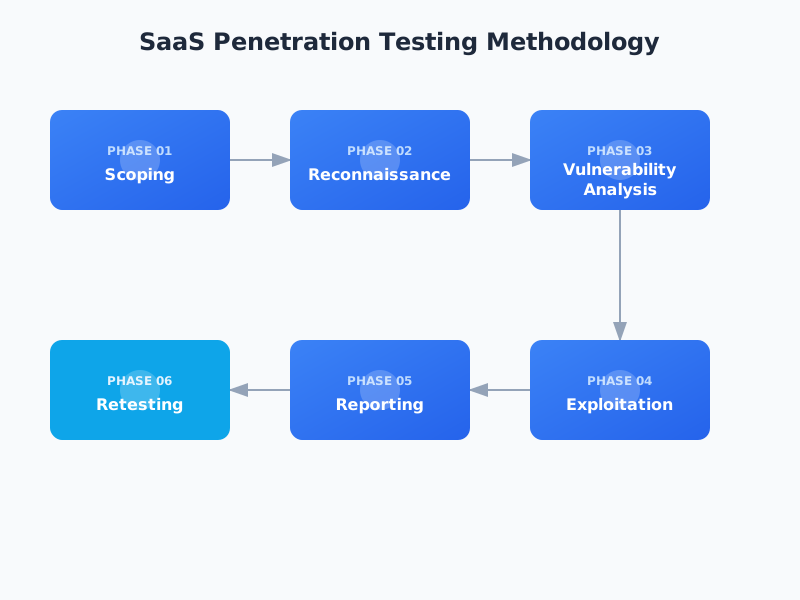 The standard 6-phase lifecycle of a professional SaaS penetration test.
- Scoping and Threat Modeling: Defining the exact boundaries of the test, understanding the application's architecture, and identifying the most critical assets (e.g., PII, financial data).
- Reconnaissance & Mapping: The ethical hackers map the entire attack surface, including subdomains, API endpoints, third-party integrations, and exposed cloud storage buckets.
- Vulnerability Analysis: Combining automated tooling with manual inspection to identify potential weaknesses in the application layer, cloud configuration, and authentication flows.
- Exploitation: Safely executing attacks to validate vulnerabilities. This is where testers attempt to chain multiple low-level bugs into a critical exploit, such as bypassing tenant isolation.
- Reporting & Remediation Guidance: Delivering a comprehensive report that details the vulnerabilities found, their potential business impact, and step-by-step remediation instructions for the development team.
- Retesting: Verifying that the development team has successfully patched the identified vulnerabilities.
How to Choose a SaaS Pentesting Provider
Not all penetration testing firms are equipped to handle the complexities of modern SaaS platforms. When selecting a vendor, look for:
- Cloud-Native Expertise: Ensure they deeply understand AWS, Azure, or GCP architectures, as well as modern frameworks like React, Node.js, and serverless deployments.
- Manual Testing Capabilities: Automated scans are not pentests. Ensure the provider emphasizes manual, human-led exploitation.
- Clear Reporting: The final report should be actionable for developers while providing executive summaries suitable for stakeholders and enterprise buyers.
Conclusion
As SaaS architectures continue to grow in complexity, the methods used to secure them must evolve in tandem. SaaS penetration testing is no longer a simple checkbox exercise; it is a critical business enabler that builds customer trust, ensures compliance, and protects your platform from devastating breaches.
By investing in a comprehensive, modern SaaS pentest, you signal to the market—and to your customers—that you take their data security seriously in an increasingly hostile digital landscape.