For years, the cybersecurity industry has preached the gospel of "shifting left." We secured our CI/CD pipelines, mandated SBOMs, and implemented rigorous automated code scanning. But as we reach the mid-point of 2026, attackers have adapted to these fortified perimeters by shifting even further left—straight to the developer's laptop.
The modern developer workstation is a paradox. It is the most privileged endpoint in your organization, often holding unencrypted access tokens, production SSH keys, and direct connections to cloud infrastructure. Yet, it is also the environment where developers routinely execute untrusted third-party code via package managers and open-source tools.
In the era of advanced software supply chain attacks, treating localhost as a safe haven is a dangerous illusion.
The Rise of the Workstation Compromise
As CI/CD platforms and code repositories have implemented stricter controls—such as mandatory hardware security keys for MFA and commit signing—attackers have realized that the easiest way to poison the software supply chain is to compromise the developer before the code ever reaches the repository.
Today, we are seeing a massive spike in highly targeted attacks aimed at engineering teams. These are not generic phishing campaigns; they are sophisticated operations designed to silently hijack the development environment.
1. Weaponized IDE Extensions
Developers love customizing their Integrated Development Environments (IDEs) with themes, linters, and productivity boosters. Attackers have capitalized on this by publishing malicious extensions to popular marketplaces.
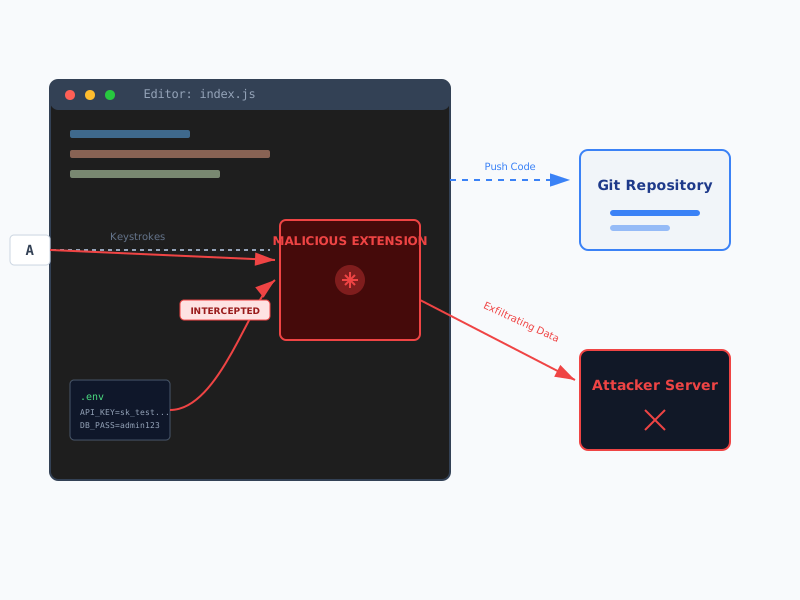 Diagram of an IDE supply chain attack: A malicious extension intercepts sensitive local data before it reaches the secure repository.
Once installed, a rogue extension operates with the same permissions as the developer. It can quietly read environment variables (like AWS keys or GitHub tokens), alter commit histories, or inject subtle backdoors into source files just before they are saved and pushed. Because these extensions run locally, they bypass repository-level security checks entirely.
2. The Local Execution Trap
When a developer types npm install, pip install, or cargo build, they are often triggering pre- or post-install scripts embedded in those packages. Attackers frequently use typosquatting or dependency confusion to trick developers into downloading malicious packages.
If a developer runs these commands on their local machine, the malicious script executes immediately, often resulting in the deployment of an infostealer. These specialized malware strains are designed specifically to harvest browser cookies, bypassing MFA and allowing attackers to hijack active sessions to cloud infrastructure and source control.
3. The "Bring Your Own AI" Risk
While enterprise AI coding assistants are heavily vetted, developers frequently experiment with unauthorized, open-source AI tools and local models. These "Shadow AI" tools often require vast amounts of local permissions and can inadvertently leak proprietary code or introduce generated vulnerabilities directly into the local workspace.
Hardening the Local Environment in 2026
Securing the developer workstation requires a fundamental shift in how we view the software development lifecycle (SDLC). The goal is no longer just to protect the endpoint, but to isolate the act of software development from the risks of the local machine.
Transition to Cloud Development Environments (CDEs)
One of the most effective strategies for mitigating workstation risk is the adoption of Cloud Development Environments (CDEs). Instead of cloning repositories and running builds on a physical laptop, developers connect to ephemeral, cloud-hosted workspaces.
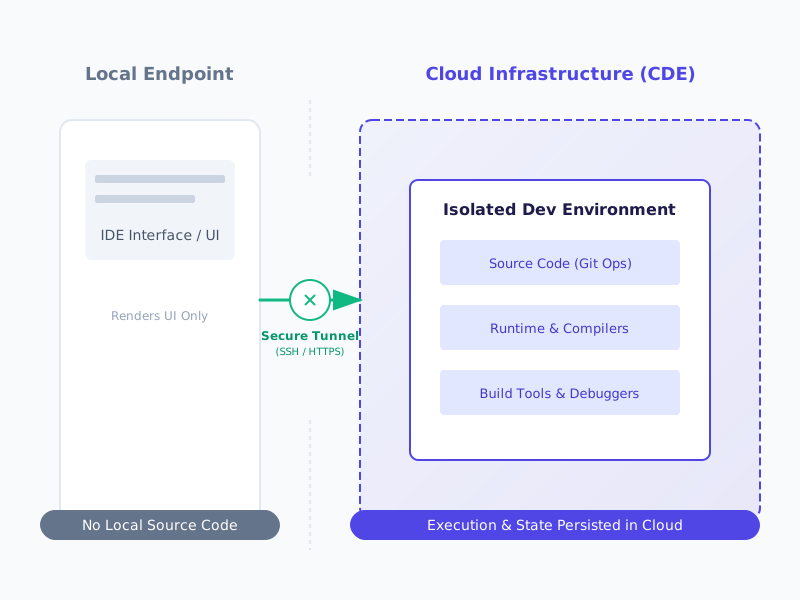 CDE Architecture: Separating high-performance compute and code storage from the developer's local machine.
CDEs offer several massive security advantages:
- Ephemeral by Design: Workspaces are spun up for a specific task and destroyed afterward, drastically reducing the dwell time for any potential malware.
- Strict Egress Controls: CDEs can be locked down so that
npm installcan only pull from a vetted internal registry, preventing unauthorized external network connections. - Zero Local Data: Source code and access tokens never reside on the developer's physical laptop, rendering physical theft or local infostealers useless.
Implement Credential Sandboxing
For teams that must develop locally, static, long-lived credentials must be eradicated. Tools that enforce Just-In-Time (JIT) access and ephemeral tokens are non-negotiable. Furthermore, local credentials should be sandboxed or heavily restricted, requiring biometric approval (like TouchID or Windows Hello) for every critical action, such as pushing code or accessing a production database.
EDR Tailored for Engineering
Traditional Endpoint Detection and Response (EDR) solutions often struggle with developer machines because developers inherently do "suspicious" things—compiling unknown binaries, running shell scripts, and manipulating network configurations. Security teams must deploy behavioral analytics specifically tuned for development environments to detect anomalies, such as an IDE extension attempting to read a .aws/credentials file or a newly installed package attempting to establish an outbound SSH connection.
Conclusion
The software supply chain does not begin at the pull request; it begins the moment a developer's fingers touch the keyboard. As long as local workstations remain highly privileged and under-secured, they will be the primary target for supply chain adversaries. By embracing Zero Trust principles in the development environment, adopting CDEs, and aggressively managing local credentials, organizations can close the most critical blind spot in their 2026 security posture.