For years, the cybersecurity community has rallied around the mantra of "shift left," pushing security testing earlier into the Software Development Life Cycle (SDLC). We've locked down CI/CD pipelines, implemented rigorous container scanning, and deployed advanced Software Composition Analysis (SCA) to catch vulnerable dependencies.
But as these traditional supply chain defenses mature, attackers are shifting even further left. Their new target? The developer's local machine—specifically, the Integrated Development Environment (IDE).
The Blind Spot in Supply Chain Security
When we think about software supply chain attacks, high-profile incidents involving compromised open-source libraries or poisoned build servers usually come to mind. However, the modern developer relies on a complex ecosystem of IDE extensions, linters, AI coding assistants, and syntax highlighters to maintain productivity.
These extensions are rarely subjected to the same rigorous security vetting as production dependencies. Yet, they operate with immense privileges. A malicious extension installed in VS Code, IntelliJ, or Cursor has the ability to:
- Read local file systems: Accessing
.envfiles, AWS credentials, and private SSH keys. - Intercept keystrokes: Capturing passwords and sensitive logic as it is typed.
- Modify code pre-commit: Injecting backdoors into source code before it ever reaches a Git repository or triggers a SAST scanner.
How IDE Attacks Unfold
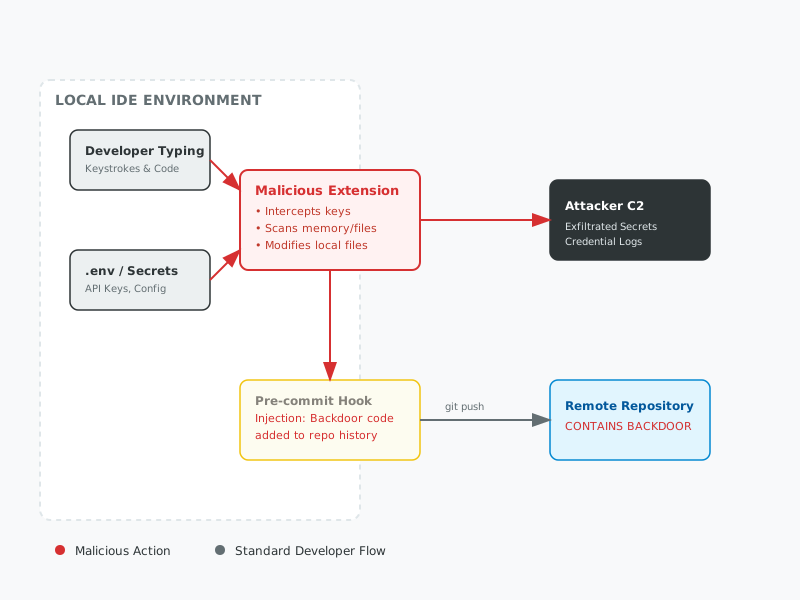 Figure 1: The lifecycle of an IDE-based supply chain attack, from initial data theft to malicious code injection.
Attackers typically leverage three primary vectors to compromise developer environments:
1. Typosquatting and Impersonation
Just as attackers publish malicious packages to npm or PyPI using names similar to popular libraries, they do the same in extension marketplaces. A developer looking for a popular formatting tool might accidentally install a malicious clone with a slightly altered name and a copied logo.
2. Compromised Publisher Accounts
If an extension developer's credentials are compromised, attackers can push a malicious update to a legitimate, widely used extension. Because IDEs often auto-update extensions in the background, thousands of developers can be infected overnight without taking any manual action.
3. The "Trojan AI" Assistant
With the explosion of AI-assisted coding, developers are eager to install new tools that promise to write boilerplate code or optimize functions. Attackers are increasingly publishing fake "AI helpers" that actually exfiltrate proprietary source code to external servers under the guise of cloud-based processing.
Hardening the Developer Perimeter
Securing the software supply chain in 2026 requires treating the developer environment as a critical production asset. Organizations must adopt a zero-trust approach to local development.
Implement Extension Whitelisting
Organizations should block the installation of unapproved IDE extensions. By maintaining a curated, vetted registry of allowed tools, security teams can drastically reduce the risk of typosquatting and rogue installations.
Transition to Ephemeral Cloud Workspaces
Moving development to isolated, cloud-based environments (like GitHub Codespaces or Gitpod) ensures that developers are working in clean, reproducible states. If an environment is compromised, it can be destroyed and recreated in minutes, and the blast radius is contained away from the developer's physical machine.
Enforce Least Privilege for Development Tools
Run developer tools and IDEs with the minimum necessary permissions. Utilize containerized development environments where the IDE only has access to the specific project directory, isolating it from global system credentials and personal files.
Conclusion
True software supply chain security doesn't start at the Git commit—it starts at the keyboard. As threat actors continue to target the path of least resistance, securing the developer environment is no longer optional. By vetting IDE extensions, utilizing ephemeral workspaces, and extending zero-trust principles to the local machine, organizations can close the most dangerous blind spot in their SDLC.