The cybersecurity landscape has undergone a seismic shift. In 2026, SaaS applications no longer just serve users — they collaborate with autonomous AI agents that can browse the web, execute code, manage infrastructure, and make decisions with minimal human oversight. This revolution in agentic AI has unlocked extraordinary productivity gains, but it has simultaneously created an attack surface that is broader, deeper, and more dynamic than anything the industry has faced before.
For organizations that build, deploy, or rely on SaaS platforms, the implications are clear: traditional perimeter-based security is insufficient. The software supply chain — every dependency, build step, container image, and third-party integration that constitutes your application — has become the primary battlefield. And verifying that your infrastructure is truly impenetrable is no longer optional. It is paramount.
The Rise of Agentic AI and What It Means for SaaS Security
Agentic AI refers to artificial intelligence systems that can autonomously plan, reason, and execute multi-step tasks. Unlike traditional AI models that respond to a single prompt and return a result, agentic systems maintain context over extended interactions, call external tools, access databases, invoke APIs, and even deploy code. Major SaaS platforms now embed these agents as first-class features — from customer support copilots that can modify account settings to development assistants that commit code directly to repositories.
The security implications are profound. When an AI agent has permission to read your database, call your APIs, and modify infrastructure configurations, it becomes a high-value target for attackers. A compromised agent does not just leak data — it can take actions. Prompt injection attacks, where malicious instructions are hidden in user-supplied content, can hijack an agent's execution flow. Indirect prompt injection, embedded in emails, documents, or web pages that an agent processes, can exfiltrate sensitive data or trigger unauthorized actions without any human ever seeing the malicious payload.
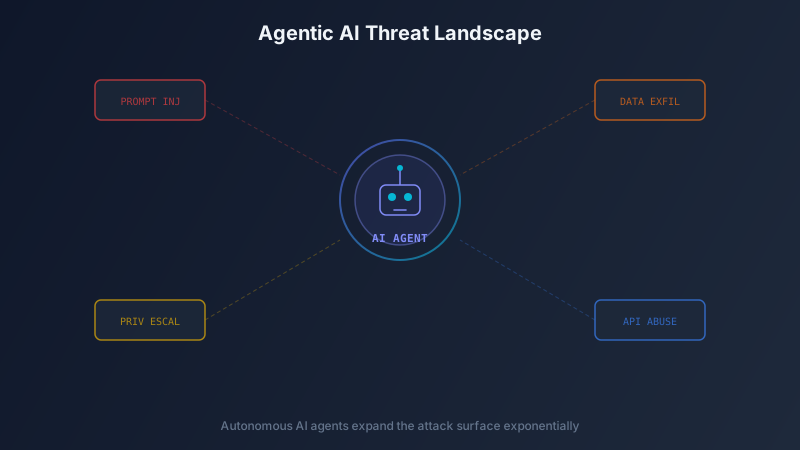 Agentic AI expands the attack surface by introducing new threat vectors that traditional security controls cannot address.
The challenge is compounded by the fact that agentic systems often operate with broad permissions. The principle of least privilege, a cornerstone of security architecture, is frequently violated in practice because restricting an agent's access limits its usefulness. Security teams must find ways to enforce granular access controls, audit agent actions in real time, and implement kill switches that can halt autonomous operations when anomalies are detected.
The Software Supply Chain: Your Biggest Blind Spot
If agentic AI is the new frontier, the software supply chain is the territory where the battles are being fought today. The statistics are alarming: supply chain attacks increased by over 300% between 2023 and 2025, and the trend shows no signs of slowing. High-profile incidents — from the SolarWinds compromise to the XZ Utils backdoor — have demonstrated that even sophisticated organizations can be breached through their dependencies.
A modern SaaS application is, in reality, a composite of hundreds or thousands of open-source packages, container base images, build tools, and third-party services. Each of these components represents a potential entry point. A single malicious package in your dependency tree can exfiltrate environment variables, steal API keys, inject backdoors into your builds, or establish persistent access that survives deployments.
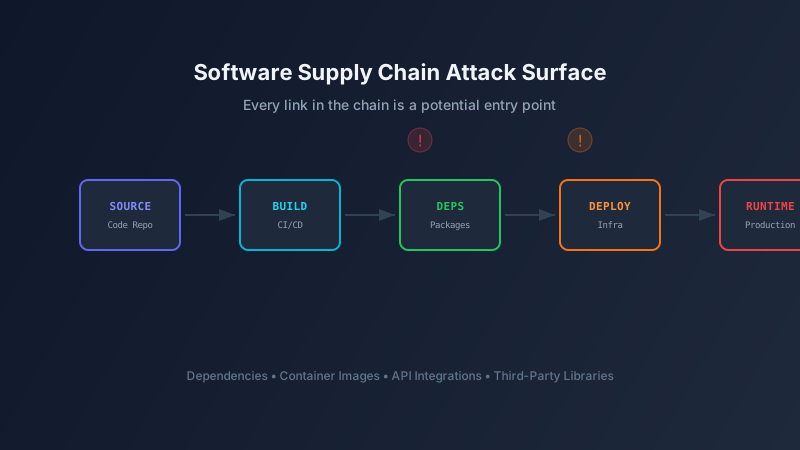 Every stage of the software supply chain — from source code to production runtime — presents opportunities for attackers to inject malicious code.
The integration of agentic AI into the development workflow adds another dimension of risk. AI coding assistants can suggest code that introduces vulnerabilities, either through training data poisoning or because the underlying models lack the context to understand security implications. When these suggestions are accepted without review — as studies show happens frequently — the resulting code becomes a supply chain risk in itself.
Building a Resilient Supply Chain Security Program
Addressing supply chain risk requires a multi-layered approach that goes beyond simply scanning for known vulnerabilities. Organizations must implement:
- Software Bill of Materials (SBOM): Maintain a comprehensive, automatically generated inventory of every component in your application. SBOMs provide the visibility needed to respond rapidly when a new vulnerability is disclosed in a dependency.
- Dependency pinning and verification: Lock dependency versions and verify integrity using cryptographic checksums. Avoid pulling packages with floating version ranges that could be silently replaced with malicious versions.
- Build provenance and reproducibility: Implement SLSA (Supply-chain Levels for Software Artifacts) framework controls to ensure your build pipeline produces verifiable, tamper-evident artifacts.
- Continuous monitoring: Deploy runtime security tools that can detect anomalous behavior from dependencies, such as unexpected network connections, file system access, or process execution.
- Vendor risk assessment: Evaluate the security posture of every third-party SaaS integration. Require SOC 2 reports, penetration test results, and evidence of secure development practices from your vendors.
Infrastructure Hardening: Verifying Impenetrability
Even with a secure supply chain, your application is only as strong as the infrastructure it runs on. Cloud misconfigurations remain the leading cause of data breaches, with exposed storage buckets, overly permissive IAM roles, and unencrypted data stores providing easy footholds for attackers. In the age of agentic AI, these misconfigurations are even more dangerous because autonomous agents can discover and exploit them at machine speed.
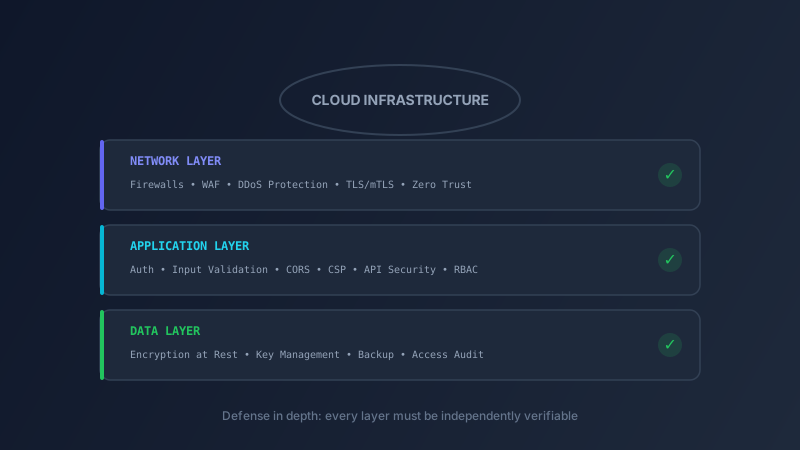 Defense in depth requires independent security verification at every layer of your infrastructure stack.
Verifying that your infrastructure is impenetrable requires a defense-in-depth strategy with rigorous, automated testing at every layer:
- Network layer: Web application firewalls (WAFs), DDoS protection, TLS everywhere, and zero-trust network architecture that verifies every request regardless of origin.
- Application layer: Strong authentication with multi-factor enforcement, input validation on every endpoint, Content Security Policy headers, CORS restrictions, and role-based access control (RBAC) that is continuously tested.
- Data layer: Encryption at rest and in transit, key rotation policies, database access auditing, and backup verification to ensure data integrity and availability.
Automated penetration testing is a critical component of this strategy. Manual penetration tests, while valuable, are point-in-time assessments that cannot keep pace with the velocity of modern deployments. Teams pushing code multiple times per day need security testing that runs at the same cadence. Platforms that can scan for SQL injection, cross-site scripting, authentication bypasses, JWT vulnerabilities, SSRF, and security header misconfigurations on every deployment provide the continuous assurance that modern SaaS applications demand.
The Convergence: Where AI, Supply Chain, and Infrastructure Collide
The most dangerous scenarios emerge at the intersection of these three domains. Consider an attack chain where a compromised open-source package introduces a subtle backdoor into a SaaS application. An agentic AI system, operating with broad permissions, processes a document containing an indirect prompt injection. The injection triggers the agent to invoke an internal API that exploits the backdoor, escalating privileges and exfiltrating customer data — all without triggering traditional security alerts.
This is not a hypothetical scenario. Security researchers have demonstrated each component of this attack chain independently. The convergence is inevitable, and organizations that fail to address all three domains simultaneously are leaving themselves exposed.
Actionable Steps for Security Teams
The threats are real, but they are addressable. Here are concrete steps that security teams can take today to protect their SaaS applications:
- Audit your AI agent permissions. Map every action your agentic AI systems can perform and enforce the principle of least privilege. Implement session-scoped permissions that expire and require re-authorization.
- Implement comprehensive SBOM practices. Generate SBOMs for every build and integrate them into your vulnerability management workflow. Use tools like Syft, CycloneDX, or SPDX to automate this process.
- Adopt automated penetration testing. Integrate security scanning into your CI/CD pipeline so that every deployment is tested for common vulnerabilities. This catches regressions before they reach production.
- Harden your infrastructure continuously. Use infrastructure-as-code scanning tools to detect misconfigurations before deployment. Run regular cloud security posture management (CSPM) assessments.
- Monitor agent behavior in production. Implement logging and anomaly detection for all AI agent actions. Set up alerts for unusual patterns — unexpected API calls, data access outside normal parameters, or privilege escalation attempts.
- Conduct supply chain threat modeling. Map your entire dependency graph and identify critical paths where a single compromised component could have outsized impact. Prioritize security reviews for these high-risk dependencies.
- Test your incident response plan. Run tabletop exercises that specifically include agentic AI compromise scenarios. Ensure your team knows how to isolate and shut down autonomous systems during an active incident.
Looking Ahead
The era of agentic AI is here, and it is transforming the security landscape as profoundly as the cloud revolution did a decade ago. SaaS applications that embrace this technology gain significant competitive advantages, but only if they do so with security woven into every layer — from the dependencies they consume to the infrastructure they run on to the AI agents they deploy.
The organizations that will thrive in this new landscape are those that treat security not as a checkbox but as a continuous process. Automated penetration testing, supply chain verification, and infrastructure hardening are not individual initiatives — they are interconnected disciplines that must operate in concert. By investing in these capabilities now, security teams can ensure that the promise of agentic AI is realized without becoming its next victim.
The attack surface has expanded. The tools to defend it have evolved to match. The question is not whether your SaaS application will be targeted — it is whether you will be ready when it is.