For a Software-as-a-Service (SaaS) business, the platform isn't just a tool—it is the entire business. Your revenue, reputation, and customer trust are inextricably linked to the security and availability of your application. Yet, many SaaS providers fall into a dangerous trap: relying on generic vulnerability scans or traditional network penetration tests to secure highly complex, multi-tenant environments.
To truly protect your platform against sophisticated modern threats, a dedicated saas pentest is no longer optional. It is a critical business imperative. Here is why standard security assessments fall short, and why specialized platform-level testing is the only way to safeguard your SaaS enterprise.
The Illusion of Standard Security Testing
Many organizations mistakenly believe that running automated vulnerability scanners or conducting standard network penetration testing is enough to check the "security box." While these methods are valuable for identifying unpatched software or misconfigured firewalls, they are blind to the intricate business logic that powers a SaaS platform.
A specialized pentest saas goes beyond the perimeter. It simulates the tactics of a real-world attacker who has already bypassed the outer defenses or, more commonly, registered as a legitimate user. Because SaaS platforms inherently allow external users to interact deeply with the application's core logic, the threat model is vastly different from a traditional corporate network.
Platform-Level Risks Unique to SaaS
SaaS architectures introduce specific vulnerabilities that only specialized human-led testing can uncover.
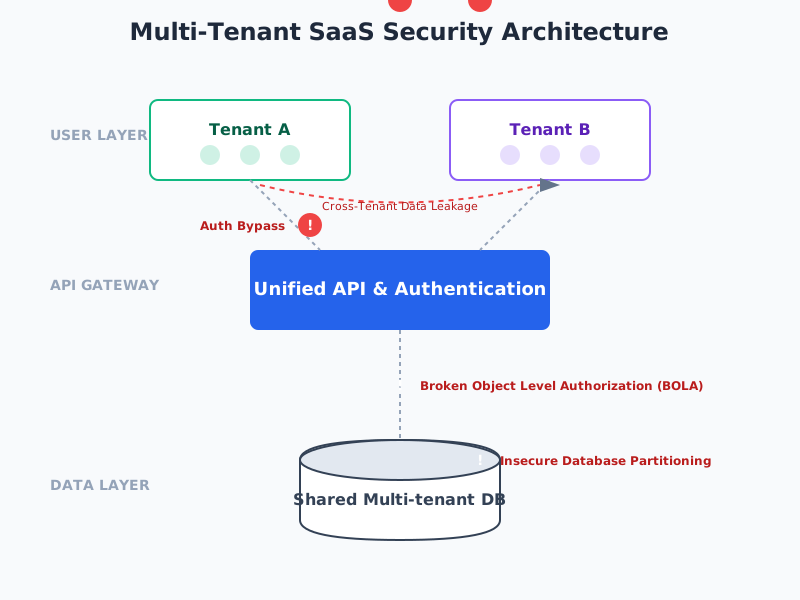 In a multi-tenant SaaS environment, critical vulnerabilities often occur at the isolation boundaries between tenants and the shared data layer.
1. Multi-Tenancy and Data Isolation (Tenant Bleed)
The defining feature of most SaaS platforms is multi-tenancy—multiple customers sharing the same underlying infrastructure and database. If data isolation controls fail, a vulnerability known as "tenant bleed" occurs. A dedicated saas pentest meticulously tests Insecure Direct Object References (IDOR) and authorization flaws to ensure that User A cannot access, modify, or delete the sensitive data of User B.
2. Complex RBAC and Privilege Escalation
SaaS platforms typically feature complex Role-Based Access Control (RBAC) systems. You have super admins, tenant admins, billing managers, and standard users. Attackers frequently exploit logical flaws in these hierarchies. A thorough assessment will test for vertical privilege escalation (a standard user gaining admin rights) and horizontal privilege escalation (a user accessing another user's account at the same permission level).
3. API Vulnerabilities and Third-Party Integrations
Modern SaaS platforms are heavily API-driven, communicating constantly with payment gateways, CRM systems, and AI microservices. Forgotten endpoints, broken object level authorization (BOLA), and insecure webhook implementations are prime targets. Penetration testers focus heavily on your API layer to ensure that integrations don't become backdoors into your platform.
The Business Value of a Specialized Assessment
Investing in a dedicated SaaS penetration test isn't just about mitigating technical risk; it directly impacts your bottom line and market growth.
- Unblocking Enterprise Sales: Enterprise buyers will not risk their data on an unverified platform. Providing a clean letter of attestation from a reputable saas pentest accelerates procurement cycles and builds immediate trust with enterprise prospects.
- Achieving Global Compliance: Frameworks like SOC 2, ISO 27001, and HIPAA require regular, rigorous security testing. Furthermore, for companies expanding globally, particularly in European markets, demonstrating localized security rigor—often requested by regional partners as a comprehensive pentest plateforme saas—is a strict baseline requirement for vendor approval.
- Protecting Brand Reputation: A data breach in a multi-tenant environment is catastrophic. It doesn't just affect one user; it affects your entire customer base. Proactive testing protects your brand equity and prevents churn.
What to Expect in a SaaS Pentest
Unlike an automated scan, a dedicated SaaS penetration test is highly customized. It typically involves:
- Authenticated Testing: Testers are provided with multiple accounts across different permission tiers and distinct tenant environments to test isolation and RBAC.
- Business Logic Abuse: Security engineers attempt to exploit workflows unique to your platform, such as manipulating billing logic, bypassing subscription limits, or abusing trial features.
- Actionable Remediation: You receive a detailed report prioritizing vulnerabilities by business impact, complete with reproduction steps and developer-focused remediation guidance.
Conclusion
Your SaaS platform is a dynamic, constantly evolving ecosystem. With every new feature release, API integration, and code deployment, your attack surface shifts. Relying on generic security testing leaves massive blind spots in your business logic and multi-tenant architecture.
By prioritizing a dedicated saas pentest, you transition from reactive defense to proactive security—protecting your customers, accelerating enterprise sales, and securing the future of your platform.