Modern software development is less about writing code from scratch and more about assembling it. Today's applications are complex mosaics of third-party APIs, open-source libraries, and containerized microservices. While this modular approach accelerates delivery, it has also expanded the attack surface, making software supply chain security a critical priority for engineering teams.
Malicious actors have realized that instead of attacking a well-defended enterprise directly, they can compromise a widely used dependency or build tool to infiltrate thousands of downstream targets simultaneously. To combat this, organizations must evolve beyond traditional perimeter defenses and adopt comprehensive DevSecOps best practices.
Here is your foundational guide to understanding modern threats and integrating robust security into your development lifecycle.
The Anatomy of Supply Chain Attacks
Supply chain attacks occur when a threat actor infiltrates a software vendor's network and employs malicious code to compromise the software before it reaches the end user. These attacks are particularly insidious because they exploit the implicit trust developers place in their tools and dependencies.
Common vectors for supply chain attacks include:
- Dependency Confusion & Typosquatting: Attackers publish malicious packages with names deceptively similar to popular internal or public libraries.
- Compromised Third-Party Code: Injecting backdoors into widely used open-source projects.
- Build Environment Breaches: Hijacking the build server or source control systems to inject malicious artifacts during the compilation process.
Because these threats bypass traditional runtime firewalls, defending against them requires baking security directly into the development and deployment workflows.
Core DevSecOps Best Practices for Supply Chain Defense
DevSecOps is the philosophy of integrating security practices within the DevOps process. When applied to the software supply chain, it ensures that every component, pipeline, and artifact is continuously verified.
1. Harden CI/CD Pipeline Security
Your Continuous Integration and Continuous Deployment (CI/CD) pipeline is the engine of your software delivery. If an attacker gains access to your pipeline, they hold the keys to your entire production environment.
Elevating CI/CD pipeline security involves:
- Implementing Least Privilege: Ensure build tools and service accounts only have the permissions necessary to perform their specific tasks.
- Securing Secrets: Never hardcode API keys, tokens, or passwords in your repositories. Use dedicated secret management tools (like HashiCorp Vault or AWS Secrets Manager) and inject them dynamically during the build.
- Immutable Build Environments: Ephemeral, single-use build runners prevent attackers from establishing persistence in your CI environment.
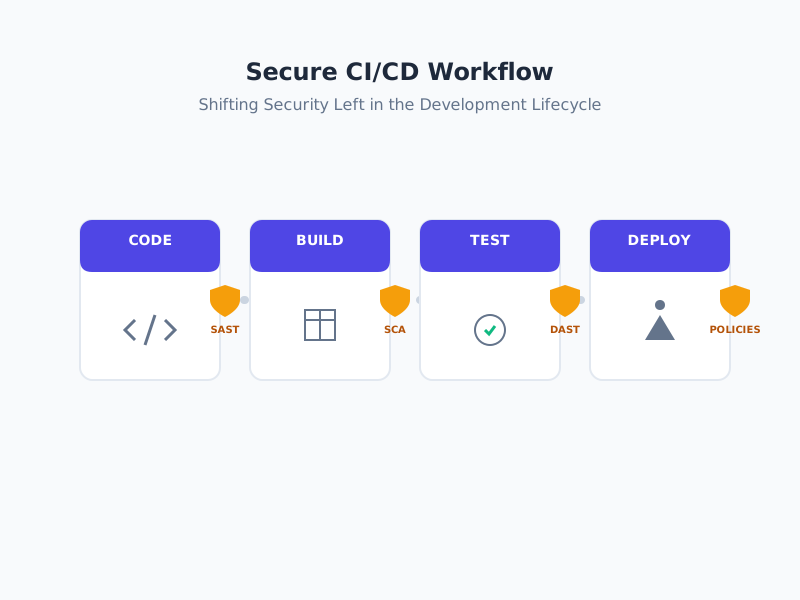 A modern DevSecOps pipeline integrates automated security scanning (SAST, SCA, and DAST) at every stage of the release process.
2. Master Open-Source Dependency Management
You cannot secure what you do not know you are using. Software Composition Analysis (SCA) tools are essential for scanning your codebase to identify all open-source components and cross-referencing them against known vulnerability databases (like the CVE list).
Automate dependency updates and establish policies to block builds that include libraries with critical, unpatched vulnerabilities. Furthermore, consider implementing internal artifact repositories to proxy and cache approved versions of external packages, insulating your team from upstream tampering.
3. Generate and Ingest SBOMs
A Software Bill of Materials (SBOM) is a comprehensive inventory detailing all the components, libraries, and dependencies that make up a software application.
Generating an SBOM during every build provides immediate visibility into your software's DNA. If a zero-day vulnerability is announced in a popular logging framework, a well-maintained SBOM allows your security team to determine your exposure in seconds rather than days. Make SBOM generation an automated, non-negotiable step in your CI/CD pipeline.
4. Enforce Code Signing and Provenance
How do you guarantee that the container image deployed to production is the exact same one that passed your security tests?
Code signing and provenance attestation provide cryptographic proof of an artifact's origin and integrity. Frameworks like SLSA (Supply-chain Levels for Software Artifacts) offer a standardized approach to tracking how software was built, ensuring that artifacts haven't been tampered with between the build and deploy stages.
Building Foundational Security
Securing the software supply chain is not a one-time project; it is an ongoing operational posture. By integrating these DevSecOps best practices into your daily workflows, you shift security to the left—catching vulnerabilities before they are merged, built, or deployed.
As supply chain attacks continue to grow in sophistication, treating your build pipelines and dependencies with the same level of security scrutiny as your production infrastructure is no longer optional. It is the new baseline for modern software engineering.