The modern cloud is built on shared foundations. Infrastructure as Code (IaC) tools like Terraform, OpenTofu, and Pulumi have fundamentally transformed how we provision environments. Instead of clicking through consoles, developers declare their desired state, and the infrastructure materializes.
But this convenience relies on a massive, often unvetted ecosystem of third-party modules. Just as npm and PyPI revolutionized application development—and subsequently became prime targets for software supply chain attacks—public IaC registries are the new frontier for threat actors.
When you pull an external module to quickly stand up an EKS cluster or configure an S3 bucket, you aren't just downloading configuration data. You are importing code that will execute with the highest possible privileges in your cloud environment.
The Anatomy of an IaC Supply Chain Attack
The fragmentation of the IaC ecosystem in recent years has led to a proliferation of public and community-driven registries. This sprawl makes it easier for attackers to introduce malicious blueprints into the wild.
An IaC supply chain attack typically unfolds in one of three ways:
- Typosquatting: Attackers publish modules with names terrifyingly similar to popular official modules (e.g.,
terraform-aws-moduels/vpcinstead ofterraform-aws-modules/vpc). - Registry Hijacking: A legitimate maintainer's account is compromised, and a malicious update is pushed to a widely used module.
- Dependency Confusion: Internal, proprietary module names are claimed on public registries, tricking the IaC runner into pulling the malicious public version instead of the safe internal one.
The "Local-Exec" Loophole
The danger of a poisoned IaC module goes far beyond misconfiguring a firewall rule. The most critical threat lies in execution context.
Tools like Terraform and OpenTofu support provisioners—specifically local-exec and external data sources. These features allow the IaC tool to run arbitrary shell commands on the machine executing the plan.
If a malicious module contains a hidden local-exec block, that script runs the moment your CI/CD pipeline executes the plan or apply phase.
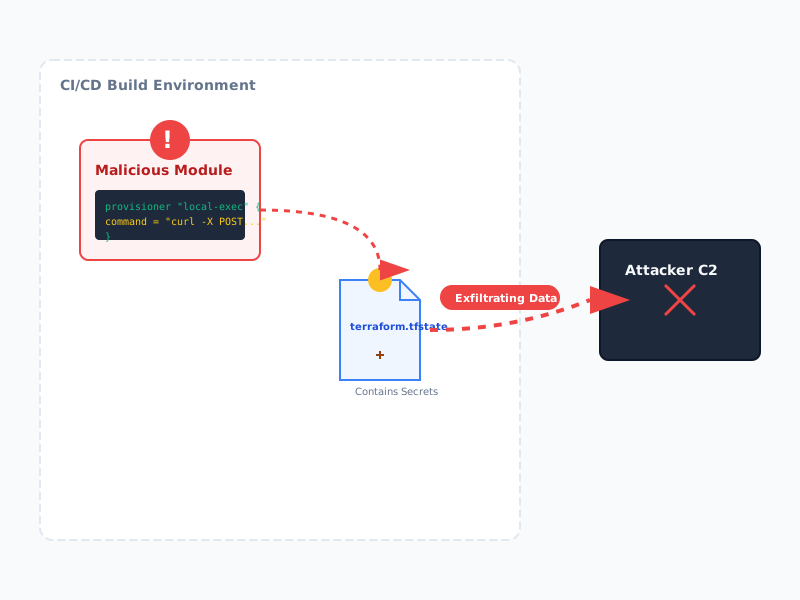 A malicious IaC module can escape its sandbox using local-exec to exfiltrate sensitive state files.
Because the pipeline runner requires broad IAM permissions to provision infrastructure, the malicious script inherits those exact permissions. Furthermore, the runner has access to the IaC state file, which notoriously stores database passwords, API keys, and TLS certificates in plaintext. The attacker doesn't even need to alter your cloud architecture; they simply exfiltrate the state file and walk away with the keys to the kingdom.
The Blast Radius: Hidden Backdoors and Shadow Access
Even without arbitrary code execution, a subtly manipulated module can wreak havoc on your cloud posture. Attackers can design modules that function exactly as advertised but include hidden, malicious resource blocks.
A poisoned module might:
- Create Shadow IAM Roles: Provision an additional, highly privileged cross-account IAM role hidden deep within the module's sub-components.
- Modify Security Groups: Silently add an ingress rule allowing SSH or RDP access from a specific, attacker-controlled IP range.
- Duplicate Data: Configure an S3 bucket replication rule that silently copies all uploaded data to an external bucket.
Because these resources are defined within the third-party module, they rarely show up in the parent repository's code reviews. Developers only see the clean, top-level module invocation.
Building a Defensible IaC Supply Chain
Securing your infrastructure blueprints requires treating IaC modules with the same rigorous scrutiny as application dependencies.
1. Pin to Immutable Hashes, Not Just Versions
Version tags can be moved or deleted. To ensure absolute consistency, pin your external modules to specific commit SHAs. If the upstream repository is compromised and the tag is altered, your pipeline will fail safely instead of pulling the malicious code.
2. Implement Module Vendoring
For critical infrastructure, do not pull directly from public registries during CI/CD execution. Instead, audit the third-party module, fork it into an internal, private registry, and consume it from there. This creates an air-gap against sudden upstream compromises.
3. Shift-Left IaC Scanning
Integrate static application security testing (SAST) tools specifically built for IaC directly into developer workstations and pre-commit hooks. Crucially, ensure these tools are configured to scan the resolved dependency tree, not just the local files.
4. Restrict Pipeline Egress and Provisioners
Implement strict network policies on your CI/CD runners. If a malicious local-exec script attempts to exfiltrate a state file, a zero-trust egress policy can block the connection. Additionally, consider using policy-as-code to outright ban the use of local-exec or external data sources unless explicitly whitelisted.
Conclusion
Infrastructure as Code is the bedrock of modern software delivery. But as the abstraction layers grow thicker, the underlying risks become harder to spot. You wouldn't let an unvetted stranger physically wire your data center servers; you shouldn't let unverified, third-party code define your cloud environment. By locking down your IaC supply chain, you ensure that your cloud foundations remain solidly under your control.