We fought for years to make Software Bills of Materials (SBOMs) an industry standard. Regulatory bodies mandated them, enterprise procurement teams demanded them, and security practitioners celebrated the end of the "black box" software era. But now, in 2026, the reality of the post-SBOM landscape has set in: we are drowning in noise.
As organizations successfully automated SBOM generation across their CI/CD pipelines, they inadvertently created a new crisis. Security dashboards are now flooded with thousands of Common Vulnerabilities and Exposures (CVEs) tied to deep-tree transitive dependencies. The problem? The vast majority of these vulnerabilities are completely unexploitable in their specific context.
Enter VEX—the Vulnerability Exploitability eXchange.
The Rise of SBOM Fatigue
An SBOM is fundamentally an inventory list. It tells you exactly what ingredients are in your software application. However, knowing that a vulnerable version of a logging library is present in your compiled application does not mean an attacker can actually reach it.
Modern applications often pull in massive libraries just to use a single helper function. If a critical CVE is published for a network-facing component of that library, standard scanners will flag your entire application as vulnerable—even if your code never imports or executes the vulnerable module.
This leads to SBOM Fatigue. Security teams waste countless hours chasing down theoretical risks, developers grow frustrated with blocked builds for non-issues, and the "boy who cried wolf" effect takes hold. When everything is a critical alert, nothing is.
Enter VEX: The Context We've Been Missing
VEX is a machine-readable security advisory designed to sit alongside an SBOM. While an SBOM tells you what is in the software, VEX tells you whether those components actually pose a risk.
At its core, a VEX document assigns one of four statuses to a vulnerability within a specific product:
- Not Affected: No remediation is required. (This is the golden ticket for curing SBOM fatigue).
- Affected: Actions are recommended to remediate or address the vulnerability.
- Fixed: The vulnerability has been remediated in this version.
- Under Investigation: It is not yet known if the vulnerability affects the product.
Crucially, when a vendor or internal security team marks a component as "Not Affected," the VEX standard requires a machine-readable justification. Common justifications include vulnerable_code_not_present, vulnerable_code_not_in_execute_path, or inline_mitigations_already_exist.
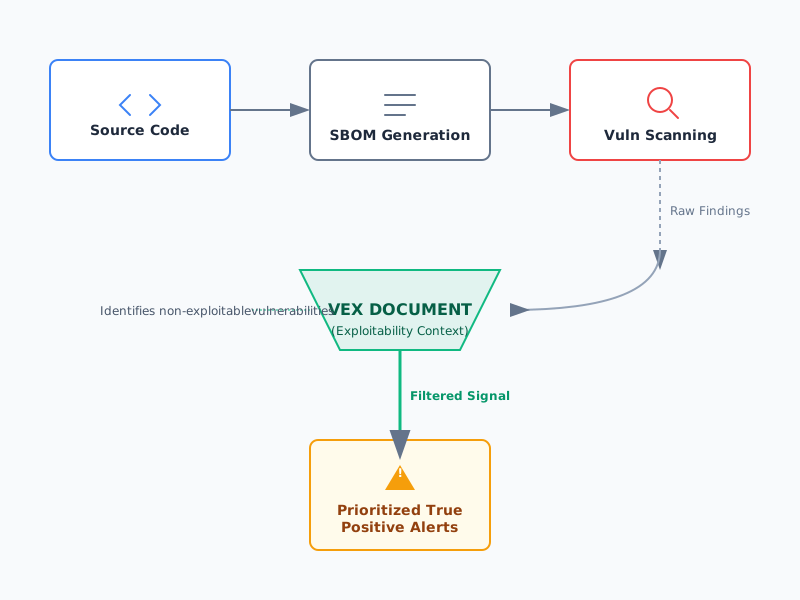 The VEX (Vulnerability Exploitability eXchange) workflow: Using context to filter out noise and focus on actionable security risks.
Automating the VEX Pipeline
The true power of VEX in 2026 isn't just in the standardized format; it's in how seamlessly it integrates into the automated software supply chain.
Forward-thinking engineering teams are now deploying VEX-aware admission controllers and CI/CD gates. Here is how the modern supply chain security workflow operates:
- Step 1: The build pipeline generates an SBOM.
- Step 2: A vulnerability scanner cross-references the SBOM against global CVE databases, generating an initial list of 500 potential vulnerabilities.
- Step 3: The pipeline ingests VEX documents from upstream open-source maintainers, commercial vendors, and internal dynamic analysis tools.
- Step 4: The VEX engine automatically suppresses 485 of those alerts because the vulnerable code paths are unreachable.
- Step 5: The security team is left with 15 actual, exploitable vulnerabilities to triage.
The Road Ahead: AI-Driven VEX Generation
The bottleneck for VEX adoption historically was the manual effort required to determine exploitability. However, the integration of Large Language Models (LLMs) and advanced reachability analysis tools is changing the game. Automated security testing suites can now trace data flows from user inputs down to the vulnerable dependency, automatically generating a VEX document with a vulnerable_code_not_in_execute_path justification if the path is physically impossible to traverse.
Conclusion
Mandating SBOMs was a necessary first step in securing the software supply chain, but visibility without context is just noise. VEX is the critical missing link that transforms raw dependency data into actionable security intelligence.
If your organization is still treating every vulnerability in your SBOM as an equal threat, you aren't doing supply chain security—you're just doing paperwork. It's time to embrace the VEX paradigm and focus your engineering resources on the threats that actually matter.