In the world of cybersecurity, trends come and go. We talk about "Vibe Coding," AI-generated exploits, and complex JWT misconfigurations. But while we chase the newest threats, one of the oldest and most devastating vulnerabilities continues to top the OWASP charts: SQL Injection (SQLi).
For a SaaS founder or lead developer, dismissing SQL injection as a "solved problem" is a dangerous gamble. Here is a breakdown of what SQLi actually is and why your application’s survival depends on checking for it today.
What is SQL Injection?
At its core, SQL injection occurs when an application takes user-supplied data and inserts it directly into a database query without proper cleaning or "parameterization." This allows an attacker to manipulate the query's logic.
Imagine a login form. The backend might run a query like this:
SELECT * FROM users WHERE email = 'user@example.com' AND password = 'password123';
An attacker doesn't need your password. They can simply enter ' OR '1'='1 into the email field. The resulting query becomes:
SELECT * FROM users WHERE email = '' OR '1'='1' AND password = '...';
Because '1'='1' is always true, the database grants access. In more severe cases, an attacker can use commands like UNION SELECT to dump your entire database or DROP TABLE to delete it entirely.
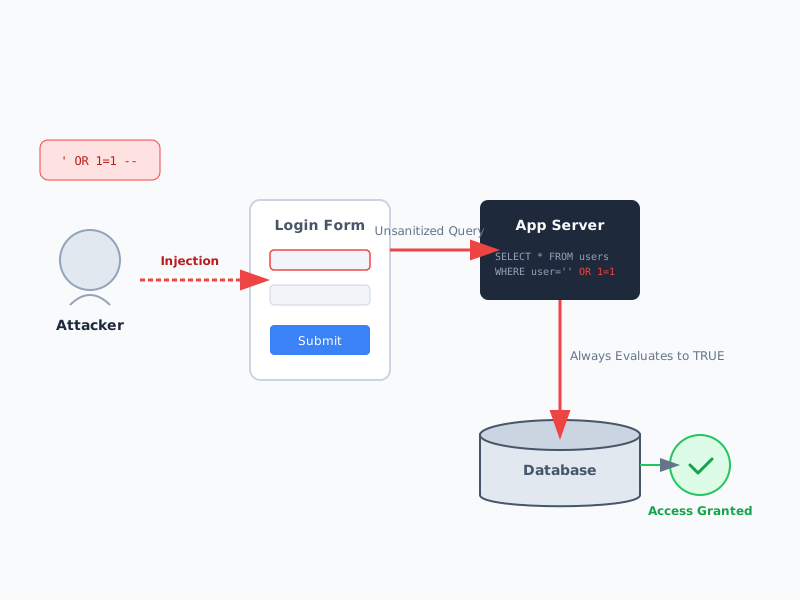 The lifecycle of a SQL Injection (SQLi) attack: from malicious input to unauthorized database access.
Why SaaS Applications are Prime Targets
While any website can be a victim, the architecture of a SaaS application makes SQL injection particularly catastrophic.
1. The Multi-Tenancy Nightmare
Most SaaS apps are multi-tenant, meaning data for hundreds of different companies lives in the same database, separated only by a tenant_id or org_id. A single SQL injection vulnerability doesn't just expose one user; it can allow an attacker to cross the "tenant boundary" and download the private data of every customer you have.
2. Compliance and Trust
If you are selling to enterprise clients, you are likely pursuing SOC2, HIPAA, or GDPR compliance. A SQL injection vulnerability is a direct violation of the data integrity and confidentiality requirements of these frameworks. One leak can result in massive fines and the immediate termination of enterprise contracts.
3. The "ORM" False Sense of Security
Many modern developers believe that because they use an Object-Relational Mapper (ORM) like Prisma, TypeORM, or Eloquent, they are immune to SQLi. While ORMs help, they are not a silver bullet. Complex reports, raw query overrides, and legacy migrations often bypass the ORM's protections, leaving the door wide open for injection.
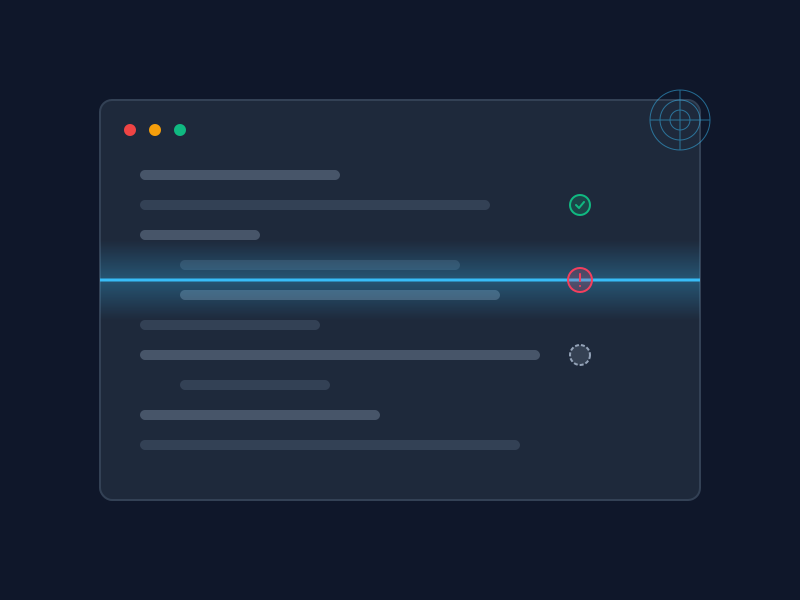 Continuous automated scanning helps identify security vulnerabilities in real-time as code is written.
How to Check Your SaaS for Risk
You cannot fix what you cannot see. Protecting your application requires a multi-layered approach:
- Parameterized Queries: Never concatenate strings to build queries. Use prepared statements where the database treats user input as data, not executable code.
- Automated DAST/SAST Scanning: Use Static Application Security Testing (SAST) to scan your codebase for vulnerable patterns and Dynamic Application Security Testing (DAST) to attempt injections against your running environment.
- The Principle of Least Privilege: Ensure your database user only has the permissions it absolutely needs. For example, the web app's database user should rarely have permission to drop tables or access system schemas.
- Input Validation: Treat every single piece of data coming from a user—even from "trusted" admins—as malicious until proven otherwise.
Final Thoughts
SQL injection might be an "old" vulnerability, but it remains one of the fastest ways to lose your business. As we move faster with AI-assisted development, the risk of injecting these classic bugs back into our code increases. Don't wait for a data breach notification to find out where your holes are.