
In the relentless push to ship new features, modern SaaS engineering teams are spinning up microservices, serverless functions, and third-party integrations faster than ever. We meticulously design our new /v3 endpoints with the latest OAuth 2.0 flows, rigorous rate limiting, and strict input validation. But what happens to /v1?
More often than not, it becomes a "Zombie API"—an endpoint that has been officially deprecated and forgotten by the development team, yet remains fully operational and exposed to the public internet.
As we navigate the complex SaaS security landscape of 2026, these undead endpoints have become one of the most lucrative attack vectors for cybercriminals. Here is why your forgotten APIs are a ticking time bomb, and how you can hunt them down before attackers do.
The Anatomy of a Zombie API
It is crucial to distinguish between Shadow APIs and Zombie APIs. Shadow APIs are endpoints that are actively used but were never officially documented or routed through standard security gateways. Zombie APIs, on the other hand, are remnants of the past.
They are the legacy mobile app endpoints from three years ago. They are the temporary webhooks created for a partner integration that ended in 2024. They are the backward-compatibility layers that everyone assumed were turned off.
Because they are no longer part of the active development lifecycle, Zombie APIs suffer from a deadly combination of security flaws:
- Outdated Authentication: While your current app uses short-lived JWTs and MFA, the zombie endpoint might still accept basic authentication or long-lived, static API keys.
- Missing Rate Limits: Older endpoints often lack the sophisticated rate limiting applied to modern infrastructure, making them prime targets for brute-force attacks and credential stuffing.
- Unpatched Vulnerabilities: When a new CVE drops and your team scrambles to patch your active services, the forgotten legacy microservice sitting in a neglected AWS account is left wide open.
How Attackers Exploit the Undead
Attackers don't just stumble upon these endpoints; they actively hunt for them. Using automated reconnaissance tools, malicious actors scrape old JavaScript files, analyze archived GitHub repositories, and fuzz URL structures looking for legacy versioning (e.g., changing api.example.com/v3/users to api.example.com/v1/users).
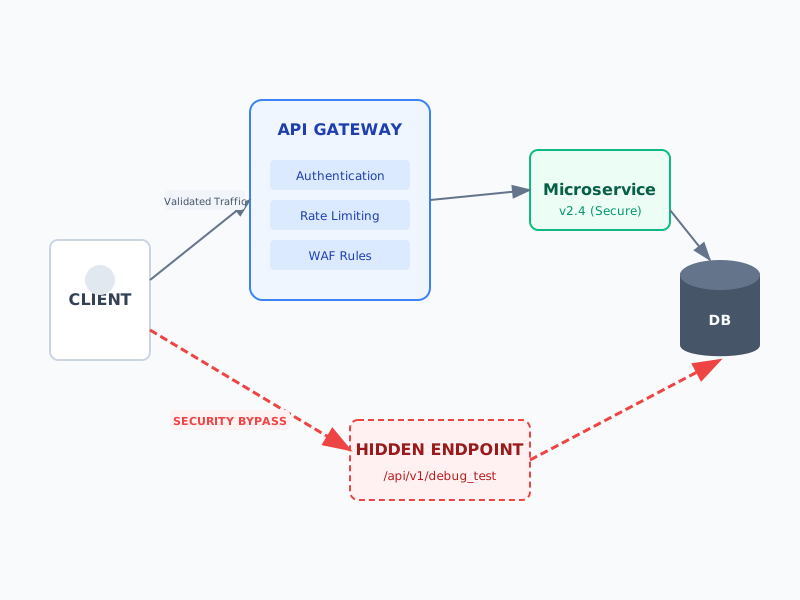 A common architectural vulnerability where 'shadow' or legacy endpoints bypass the security controls of a central API Gateway.
Once an attacker discovers a Zombie API, they bypass your modern Web Application Firewall (WAF) and API gateway rules entirely. They are interacting with the ghosts of your past architecture.
Consider a scenario where a SaaS platform upgraded its authorization model to implement strict Role-Based Access Control (RBAC) in version 2 of its API. If version 1 is still accessible, an attacker can simply route their requests through the v1 endpoint to achieve Insecure Direct Object Reference (IDOR), manipulating data they shouldn't have access to, completely sidestepping the new RBAC implementation.
Hunting the Undead: A Mitigation Strategy
Eradicating Zombie APIs requires a shift in how engineering teams view the software development lifecycle. Sunsetting code must be treated with the same rigor as shipping code.
1. Implement Continuous API Discovery
You cannot secure what you do not know exists. Relying on manual documentation like Swagger or OpenAPI specs is insufficient, as these only reflect what the team thinks is running. Deploy dynamic API discovery tools that analyze actual network traffic to build a real-time inventory of every endpoint receiving requests.
2. Enforce Strict Deprecation Lifecycles
When an API version is deprecated, it needs a hard, scheduled execution date. Communicate this timeline clearly to clients, monitor the declining traffic, and when the date arrives, physically tear down the infrastructure. Do not simply remove the links from your frontend client; sever the backend connection.
3. Centralize Your API Gateways
Ensure that all external traffic, regardless of its destination, routes through a centralized API gateway. This prevents rogue microservices from being directly exposed to the internet and ensures that baseline security policies (like global rate limiting and IP blocking) apply universally, even to legacy code.
4. Continuous Penetration Testing
Modern DAST (Dynamic Application Security Testing) tools should be configured to fuzz for common legacy endpoint patterns. Security teams should actively attempt to access deprecated versions of active APIs during routine audits.
Conclusion
In the rush toward innovation, it is easy to leave a trail of digital debris in our wake. But in the realm of SaaS security, forgotten code is not harmless—it is a liability. By implementing continuous discovery, enforcing strict sunsetting protocols, and centralizing traffic management, you can ensure that your legacy endpoints stay buried for good.