
The open-source ecosystem is built on a foundation of trust, collaboration, and shared effort. But what happens when the original creators simply walk away?
In 2026, the software supply chain is facing a silent epidemic: Zombie Dependencies. These are open-source packages and libraries that have been abandoned by their maintainers but remain deeply embedded in the dependency trees of enterprise applications. While security teams are hyper-focused on patching active zero-days and securing their CI/CD pipelines, threat actors are quietly hunting for these forgotten projects to use as backdoors.
Here is why orphaned packages are becoming the ultimate blind spot in software composition analysis (SCA)—and how you can defend your supply chain against them.
The Anatomy of an Orphaned Package Hijack
Unlike traditional vulnerabilities where an attacker exploits a flaw in actively maintained code, zombie dependency attacks rely on administrative takeovers. When a project is abandoned, it becomes vulnerable to several distinct hijacking vectors:
- Maintainer Domain Expiration: This is currently one of the most prevalent attack vectors. A maintainer abandons a project and eventually stops paying for their personal domain name. An attacker registers the expired domain, sets up a catch-all email address, and initiates a password reset on package registries like npm, PyPI, or RubyGems. Suddenly, the attacker has publishing rights.
- Social Engineering the Handover: Attackers often pose as enthusiastic contributors willing to take over the burden of maintaining a legacy package. Exhausted maintainers, happy to hand off the responsibility, transfer ownership. The attacker then waits weeks or months before slipping malicious code into a minor version bump.
- Namespace Squatting on Re-architecture: When a legacy package is deprecated in favor of a new naming convention, attackers quickly register the old, abandoned namespace. Any automated build systems or AI coding assistants that hallucinate or rely on the old package name will inadvertently pull the malicious payload.
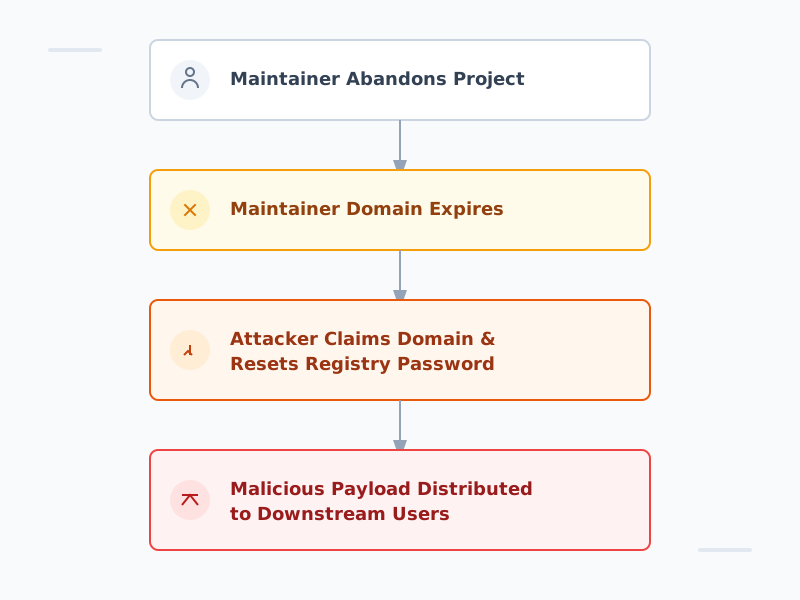 The lifecycle of an orphaned package hijack: how a neglected project becomes a supply chain attack vector.
Why Traditional SCA Tools Are Blind to Zombies
Most organizations rely on Software Composition Analysis (SCA) to secure their dependencies. However, traditional SCA tools are fundamentally reactive: they scan your manifests against databases of known Common Vulnerabilities and Exposures (CVEs).
If a package hasn't been updated in four years, it likely doesn't have any recent CVEs attached to it. No one is researching it, no one is fuzzing it, and no one is reporting bugs. To a standard SCA scanner, a zombie dependency looks perfectly healthy.
When the package is eventually hijacked and a malicious update is pushed, the payload executes during the build process or at runtime long before a CVE is ever filed. By the time your SCA tool flags the malicious version, the threat actor has already exfiltrated your environment variables or established persistence.
Defending Against the Undead
To protect your software supply chain from orphaned package hijacking, security and engineering teams must shift their focus from purely vulnerability-based metrics to health-based metrics.
1. Monitor Open Source Health, Not Just CVEs
Your dependency checks should evaluate the vitality of a project. Institute policies that flag or block packages exhibiting signs of abandonment:
- No commits or releases in the last 18-24 months.
- Archived GitHub repositories.
- A high ratio of unaddressed pull requests and issues.
- Maintainer accounts that have been inactive across the broader ecosystem.
2. Lock Down Dependency Resolution
Never allow your build pipelines to pull dynamic versions (e.g., using ^ or ~ in package.json). Enforce strict version pinning and utilize lockfiles (package-lock.json, Cargo.lock, etc.) to ensure that your builds are deterministic. If an attacker pushes a malicious update to an orphaned package, strict pinning ensures your pipeline won't automatically download it.
3. Implement Internal Registries and Proxies
Route all external package requests through an internal registry or proxy (like Jfrog Artifactory). This allows you to cache known-good versions of legacy dependencies. If an upstream package is suddenly modified or replaced, your internal proxy can block the hash mismatch, preserving the integrity of your builds.
4. Audit AI-Generated Code for Legacy Imports
As AI coding assistants become ubiquitous in 2026, we are seeing a rise in "AI-induced regressions." LLMs trained on older datasets frequently suggest importing legacy, unmaintained packages to solve modern problems. Ensure your code review processes specifically scrutinize AI-generated imports for project vitality.
Conclusion
Securing the software supply chain requires more than just tracking what is actively malicious; it requires auditing what has been quietly forgotten. Zombie dependencies represent a massive, unmonitored attack surface. By incorporating project health metrics into your CI/CD pipelines and aggressively pruning unmaintained libraries, you can ensure your application doesn't become the next victim of an orphaned package hijack.